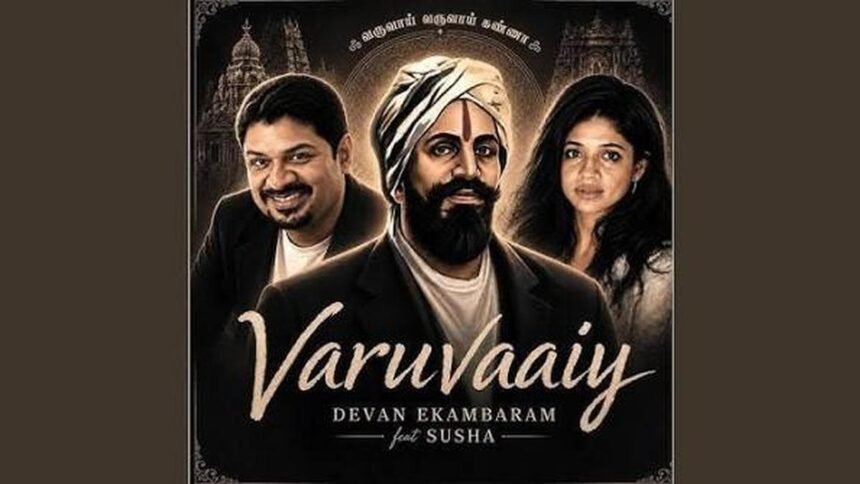
Chennai: There could not have been a happier moment for Tamilians the world over than when ‘Varuvaaiy’ was announced as the only Indian entry nominated for the 69th Annual Grammy Awards — making it the first Tamil song to earn a Grammy nomination.
The track is in the final five nominees in the Best Global Music Performance category, alongside international stars such as Angélique Kidjo, Pharrell Williams, Shakira and Burna Boy.
However, amid the jubilation, it has emerged that the track was not an original composition by the lead artistes.
The Rules
The Recording Academy’s rules require tracks submitted in the Best Global Music Performance category to be new recordings, released within the annual eligibility period and recorded no more than five years before release.
This does not mean the song itself has to be newly composed — covers, folk and traditional pieces, and reinterpretations of existing works can also qualify.
Whether or not Grammy rules explicitly mandate credit to the original composer, the article argues the lead artistes could certainly have honoured the work of L. Krishnan, a renowned composer who created several songs for leading Carnatic vocalists of his time.
The Track
The song features Devan Ekambaram as arranger and producer, with Susha (Subiksha Rangarajan) on vocals. The new rendition, with contemporary orchestration, features Anil Srinivasan on piano, Prakash Sontakke on slide guitar, Joseph John on bass and Sarvajit Krishna Mohan on tabla.
The Composer’s Son Speaks
Following the nomination, Krishnan’s son, K. Arun Prakash, revealed in an Instagram video that the tune had originally been composed by his father.
“Somebody sent me the Grammy-nominated track, asking if it was my father’s composition. It was then that I listened to it and recalled that my father had composed the song in Raag Desh for Carnatic vocalist Nithyasree Mahadevan sometime in 1989 or 1990, for her album of Bharatiyar songs,” he said.
“It is hurtful that my father was not given due credit. I understand that his name has now been included, but this should have been done when the decision to use the song was made. The purpose of this post is to ensure that such errors do not happen in the future.”
Susha’s Acknowledgement
In an Instagram post, Susha expressed elation over the nomination and the love she had been receiving, saying that as a young girl she had learnt the song from her musician-mother, Lakshmi Rangarajan, who in turn had learnt it from an audio tape of Nithyasree.
“It was set to tune by Krishnan mama, who is a very loved tunesmith. He is not with us anymore, but lots of time he tuned songs for me,” she said.
The article notes: “While the verbal acknowledgement is welcome, the original composer ought to have been credited when the song was first released.”
The Wider Questions
Devan has been part of the South Indian film industry for over two decades, and in July became a voting member of the Recording Academy.
Concerns surrounding artistic ownership and creative rights have persisted for decades. Though independent artistes and bodies such as the Indian Performing Right Society (IPRS) have consistently flagged the issue, the responsibility ultimately rests with those who use others’ creative work to respect their effort, imagination and intellectual property.
The Recording Academy’s decision to make non-original compositions eligible could add to existing copyright chaos, the article suggests. If the intention is to bring older works into the limelight — as with ‘Varuvaaiy’, which celebrates Tamil revolutionary poet Subramania Bharati’s verse — the rules could be amended to ensure original composers receive due credit rather than fading into oblivion.
Other Grammy Controversies
This year’s nominations have again drawn debate. Much online discussion has centred on Madonna and Noah Kahan missing out in the top categories, and the Academy has faced backlash over nominations for Kanye West and Chris Brown given their past records.
Last year, members of BTS chose not to submit an entry in protest against the introduction of the ‘Best Asian Pop Music Performance’ category, arguing music should not be divided along geographical or linguistic lines.
Incidentally, the Best Global Music Performance category was formerly known as Best World Music Performance — renamed because the term “world music” carried colonial connotations.
The 69th Grammy Awards will be held on February 7, 2027.