Chennai: Dorothy, written and directed by Karthik Subbaraj, was released in theatres on September 25 and has taken viewers by storm. Set in rural Madurai in the 1990s, it follows two young men, Subbu and Karthi, and the rigid ideas of masculinity and caste that test their friendship. When Dorothy arrives in their village, her presence challenges all their assumptions. Sananth, Rishikanth and Keerthy Suresh play the principal roles, alongside Muthukumar as a powerful moneylender.
But as the humans of Dorothy impose their systems of domination and control on one another, try as they might, the natural world itself remains indifferent to the social hierarchies they consider so crucial.
The Rooster Motif
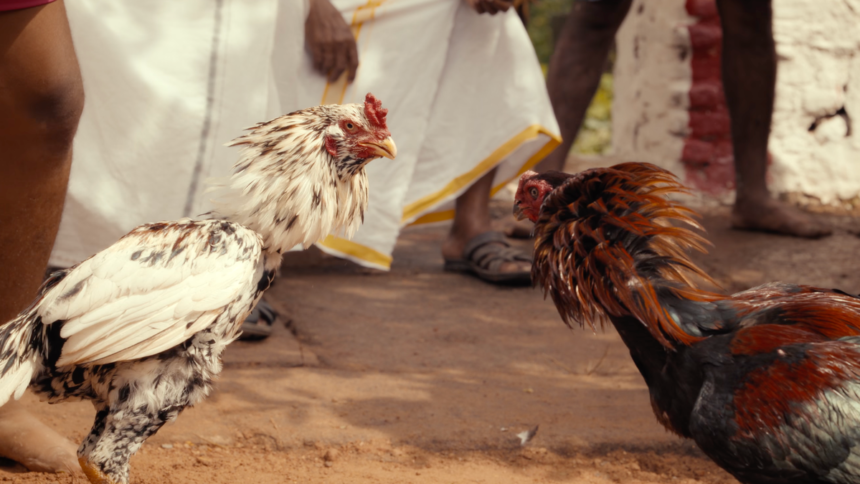
In a recent interview, Mr. Subbaraj said he based the motif of the rooster in the film — which Subbu names and nurtures — on his research into Bahuchara Mata, a Hindu goddess associated with transgender communities whose mount is a rooster. A festival centred on this deity is a guiding light in the film. Mr. Subbaraj also said the motif inspired the cockfighting scenes, and that he included it both to represent a piece of the Madurai landscape and to connote a higher meaning.
Animals as Mirrors of Human Cruelty
Many of the other animals in Dorothy are similarly part of the material world of rural Tamil Nadu and represent the human relationships unfolding within it. Some are captured and slaughtered, forced to fight, or turned into weapons against other people. On the other hand, the scorpion and the dung beetle act independently of human concerns, and in one serendipitous moment, set Karthi’s and Subbu’s shared journey on a very different path.
The skinned hare suspended from the ceiling in the house of Veeraiya, the local moneylender and Subbu’s father, paints an obvious picture of vulnerability stripped of protection — not coincidentally displayed in the home of a man who controls others through economic dependence and caste power. There is also a disturbing parallel between the hare and Dorothy herself. The house is not just a place where people destroy vulnerable bodies but also normalise the cruelty of such actions.
Members of Veeraiya’s community also breed, train and pit roosters and rams against one another for entertainment. The visual meaning is obvious: it is the men who are really aggressive and territorial, seeking dominance over others. Their masculinity is animalistic. Yet all the cruelty we see on screen, especially all that matters to Dorothy, is entirely human — arising from caste, property, honour and gender expectations rather than anything nature imposes.
When the ram headbutts a man to death, an animal becomes an instrument of human judgment. The violence is organised and conferred a social purpose, turning the scene into a commentary on men who have conditioned themselves to fight and prove their masculinity.
The Scorpion as Agent of Redemption
The scorpion is mindless of human authority and, by being itself, accidentally frustrates Karthi’s plan for a murder. When Karthi is treated for the sting, Subbu asks the doctor whether the poison has left his body — a question as much about the literal poison as the foul ideas filling his head and heart. The scorpion has thus become an agent of redemption.
The Dung Beetle’s Cosmic Perspective
The dung beetle makes a curious, even amusing appearance. It has nothing to do with the plot, yet it cuts perhaps the most memorable figure — rolling a dung ball as three men brawl in the background. The choice reverses our usual hierarchy of attention. As the men risk their lives over pernicious social expectations, rolling around in the figurative excrement they themselves have laid, the beetle simply gets on with its own business, thoroughly unbothered.
Dung beetles also find their way using the moon and stars, being guided by the cosmos itself, whereas the people nearby have evidently lost their moral bearings.
The Landscape Itself
The animals in the film were computer-generated. The landscape, however — from hilltop grasses to weeds in the dilapidated pond, from overgrown shrubs to forests in the distance — is real in both senses and just as important. As cinematographer Tirru said in an interview, the filmmakers deliberately placed people against these views to reveal the smallness of the men’s egos and the irrelevance of their prejudices within the world at large.
Overall, the animals of Dorothy do not create a unified allegory — the cattle, for instance, are just there to reinforce the film’s rural locale. But even though they were simulated on a computer, many of the animals that do make an appearance, especially in moments of violence and vulnerability, deserve our attention.