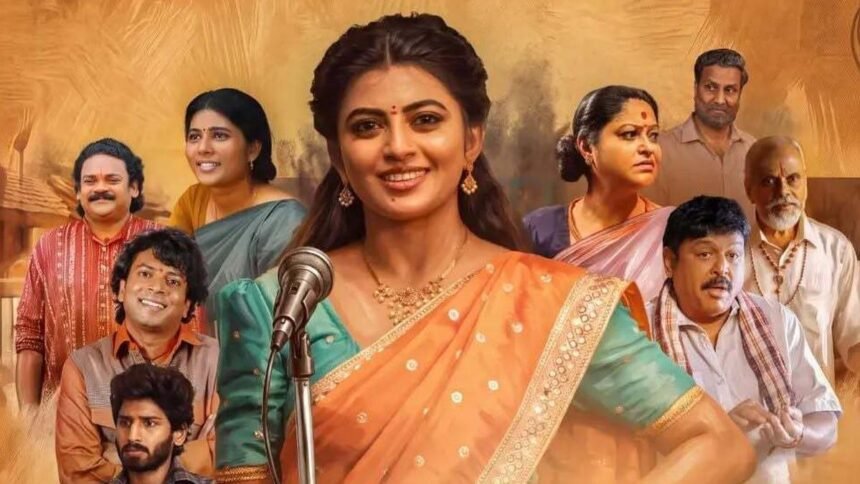
Hyderabad, India – Biopics of popular figures are often a viable prospect for storytellers to garner attention. Yet cinema becomes a more potent and effective tool to generate awareness when it spotlights an unsung icon. The life story of Garividi Lakshmi, Srikakulam’s forgotten burra katha artist, is one such gold mine, offering a rich tapestry of emotions that merits the big screen. A gifted voice from the 1990s, Lakshmi accidentally took to stage performances and tasted overnight success. Eventually, the success nearly consumed her and prompted her to withdraw completely from the public eye.
First-time director Gowri Naidu Jammu gives her biopic, named after her and played by Anandhi, a meta-autobiographical touch, unpacking the mysteries of her life through the pursuit of an emerging, indifferent filmmaker. Much like him, viewers discover Garividi Lakshmi’s forgotten glory and riches-to-rags story through various anecdotes that help piece the puzzle together. The childhood episodes, in which she is raised by a single mother in a dysfunctional family and married off at 12, only to be betrayed by her husband, define her worldview on relationships. Lakshmi never quite chases validation or fame.
Beneath the saga of love, loss, and betrayal that spans decades—serving also as a cautionary tale on sudden fame—it is possible to sense the filmmaker’s fondness for simpler times. When Garividi Lakshmi’s troupe faces rejection from audiences tired of age-old myths and historical stories, they turn to observing the crowds, seeking insight into the songs that envelop everyday life. Over the course of the story, live performances gradually make way for the cassette era. The decline of burra katha coincides with the rise of recording dance culture and the fetishisation of female performers. Garividi Lakshmi, aware of changing audience tastes and the possibility of becoming obsolete, wears fame lightly, craving only the solace of her on-and-off-stage companion, Satti Babu (Rag Mayur).
Yet the narrative, with a heavy Mahanati hangover in its rise-fall-redemption template, turns slightly repetitive as the director constantly paints Lakshmi as a perpetual victim. People come and go, experiences change, but this label remains a constant. While Garividi Lakshmi gets a lot of the cultural specifics around the burra katha tradition and the Srikakulam slang right, the film views the changing winds of the music industry in a conservative light, treating every outsider as a potential threat. Crucially, the film’s reverential outlook towards Lakshmi also means that her evolution as a musician is taken for granted.
Composer Charan Arjun’s rooted album, featuring Garividi Lakshmi’s raw, energetic numbers alongside his own compositions, is the film’s lifeline, lending authenticity to the backdrop. Anandhi lends gravitas to a character subjected to extreme experiences beyond the grasp of her age and who learns life the hard way. Rag Mayur strikes form as Satti Babu, terrific with his diction and character histrionics. Garividi Lakshmi limits the appeal of its material with an overly familiar, old-school treatment, but what works is the sheer appeal of the dramatic story and a woman’s indefatigable grit and grace in the face of victory, failure, and obscurity.