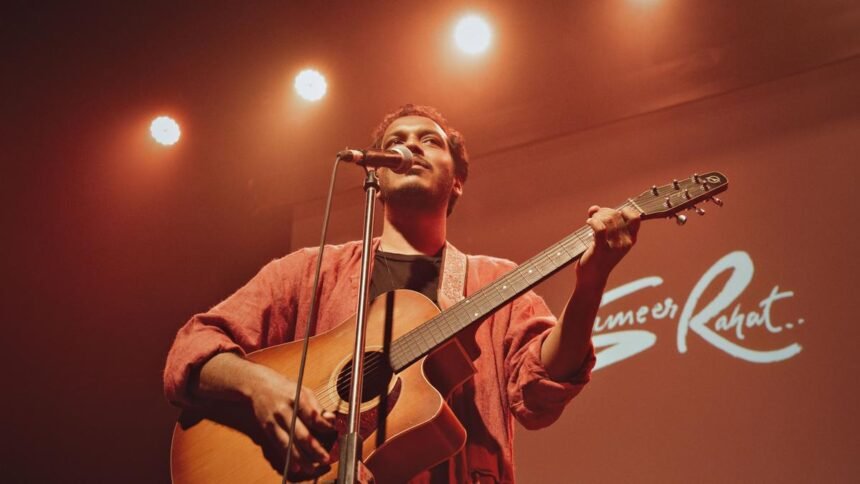
On a warm spring evening at The Piano Man in Delhi’s Jor Bagh, the audience was expecting a typical ghazal night – a man with a harmonium, perhaps a tabla, and verses of unrequited love. Instead, they were met with 808 beats, modular synthesisers, and the haunting voice of Sameer Rahat reciting Meer Taqi Meer.
This is the new face of Urdu poetry. And it is going viral.
From Agra to ambient electronica
Sameer Rahat grew up in Agra, surrounded by the rhythmic cadence of his father’s shayari sessions. He learned Urdu as a script, not just a spoken language – a rarity in post-Partition India. But unlike traditional poets, he was also listening to Massive Attack, Bon Iver, and Nils Frahm.
“For years, I felt torn. I loved the poetry of Ghalib and Momin, but I also loved the production of James Blake. I thought, why can’t they live together?” Rahat told The Hindu.
They can. And they do.
The birth of ‘Shehar’
Rahat’s debut project ‘Shehar’ (2025) was a quiet sensation. It opened with the sound of a bustling Old Delhi street – rickshaw bells, hawkers, pigeons – before dissolving into a glacial ambient track layered with the voice of a young woman reading Faiz Ahmed Faiz’s ‘Bol Ke Lab Azaad Hain’.
“I didn’t want to just recite poetry over a beat. I wanted to create a world. The city is a character in every poem I’ve chosen,” he explains.
The EP, self-produced in his bedroom studio, has crossed 5 million streams across platforms. Each track pairs a classical Urdu poem with a distinct electronic subgenre: glitch for the chaos of urban life, ambient for nostalgia, downtempo beats for the restlessness of young love.
Coke Studio and ‘Mulaqaat’
Last month, Rahat was featured on Coke Studio Bharat, performing a reworked version of Kalam Meer’s 18th-century marsiya. The stripped-down arrangement – just his voice, a cello, and subtle electronic textures – went viral, accumulating 15 million views within two weeks.
Young listeners, many of whom cannot read the Nastaliq script, commented with transcriptions in Devanagari and Roman, trying to decode each sher. Some cried in the comments section.
“That is the power of music. It becomes a gateway. If they discover Meer through my voice, and then go read him themselves, I have done my job,” Rahat says.
His upcoming album ‘Mulaqaat’ (Meeting) is scheduled for release in August 2026. The album features collaborations with Sufi vocalist Zainab Khan and electronic producer Sandunes.
Bringing poetry to the people
Rahat has taken his project to venues usually untouched by Urdu poetry. He has performed at techno clubs in Berlin, at a literature festival in Jaipur, and in the courtyard of a 300-year-old haveli in Ahmedabad. Each performance adapts to the space: seated, cross-legged for intimate gatherings; standing, with a live drummer, for festival crowds.
“I don’t want to preserve Urdu poetry in a museum. I want it to be alive, to breathe, to grow. And for that, it needs new sounds, new audiences, new contexts,” he says.
A collaborative spirit
Rahat also runs an open call on Instagram, inviting poets to send their work, from which he selects one each month to set to music. He also runs a podcast where he breaks down a single sher for 15 minutes – not academically, but viscerally, explaining what it means to feel that verse in 2026.
The future
For the classically trained, Rahat’s approach sometimes raises eyebrows. A ghazal purist once told him he was “destroying the sanctity” of the form. Rahat smiled and thanked him.
“If a 300-year-old verse can be destroyed by a synth pad, it wasn’t a very strong verse to begin with. Great poetry can take it. It has survived the printing press, the microphone, the cassette, YouTube, and now, my computer. It will survive me.”
As Rahat stepped off the stage at The Piano Man, the applause was not the polite clapping of a mushaira. It was cheers, whistles, and requests for an encore. A young woman in the front row held up her phone. On the screen, she had typed a verse of her own.
He smiled, and asked her to read it aloud.