On 29 May 1997, American singer-songwriter Jeff Buckley walked into the waters of Wolf River Harbour in Memphis, Tennessee, while waiting for his bandmates to arrive for sessions that would become his tragically unfinished second album. He was 30 years old — the creator of a single studio album, Grace (1994), and one of the most distinct voices in modern music .
The accident that killed him froze his career in a permanent state of possibility. It also froze a remarkable artistic relationship that had connected a New York rock musician to a legendary Pakistani maestro, thousands of miles away .
‘He’s my Elvis’
That relationship began in 1990 in Harlem, New York, when Buckley first heard the voice of Nusrat Fateh Ali Khan, the Pakistani “Shahanshah-e-Qawwali”. In liner notes written six years later, Buckley recalled standing smitten in his roommate’s room while Nusrat’s music poured from the speakers. He did not understand Urdu, yet he felt himself pulled into the emotions through sound alone .
He described hearing “the clarion call of harmoniums dancing the antique melody around”, followed by “the rising of one, then ten voices hovering over the tonic like a flock of geese ascending into formation across the sky”. The encounter convinced him he had stumbled onto an entirely different understanding of what a human voice could do .
Buckley’s fascination became an obsession. He amassed hundreds of Qawwali cassettes, learned Urdu phrases, covered Nusrat’s seminal Yeh Jo Halka Halka Suroor Hai in near-perfect Urdu during performances at Sin-é — the small East Village café in Manhattan where he built his early following — and regularly introduced audiences to the singer who remained unfamiliar to many American listeners. He referred to Nusrat with a phrase that has since remained in music folklore: “He’s my Elvis” .
The interview: A disciple meets his teacher
In January 1996, Interview magazine arranged a conversation between Buckley and Khan in New York. The sweet exchange carried the intimacy of a disciple meeting a teacher. Early in the interview, Buckley told Khan that “Yeh Jo Halka Halka Suroor Hai”, the first Qawwali he had ever heard, “saved my life” .
The conversation moved through music, family, and spiritual practice. Khan recounted the famous dream that followed the death of his father, in which his father touched his throat and instructed him to sing. Buckley responded with a story of his own — hiding his musical ambitions from his father, and a dream in which Tim Buckley crashed through a window at a time when Jeff felt creatively frozen .
What makes the meeting remarkable three decades later is the improbability of its circumstances. A Pakistani Qawwal trained within a hereditary musical lineage met an American alternative-rock singer. They spoke through an interpreter. They came from different continents, languages, and religious traditions. Yet both understood music as a force capable of carrying emotional meaning beyond words .
‘’“Relentless endless joy peaking into tears, resting into calmness, a simmering beauty. If you let yourself listen with the whole of yourself, you will have the pure feeling of flight while firmly rooted to the ground… Your soul can fly outward stringed to your ribcage like a shimmering kite in the shape of an open hand.”’’ — Jeff Buckley, journal entry about Ustad Nusrat Fateh Ali Khan
A friendship frozen in time
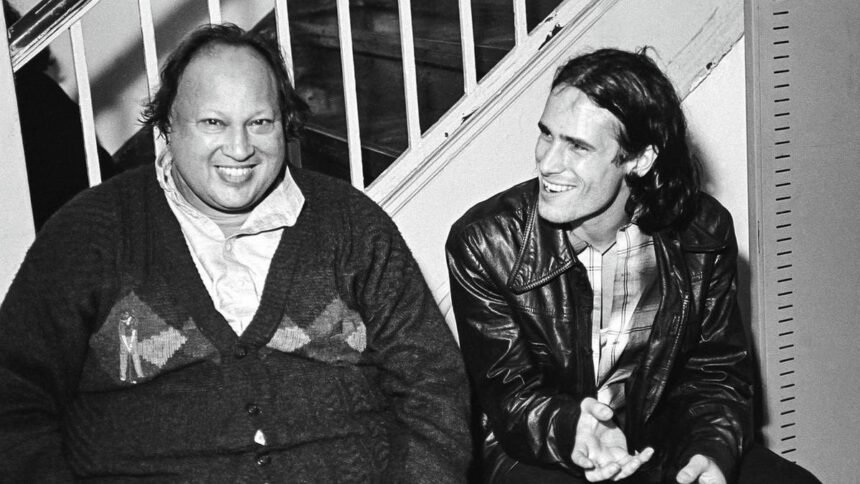
Their friendship lasted only a short time. Buckley finally met his musical hero in January 1996. He died sixteen months later. Khan died eleven weeks after that. The friendship entered the historical record almost entirely through one conversation and a handful of photographs .
They produced no album, nor any formal collaboration. But they did produce a documented conversation between two musicians who recognised each other immediately across every apparent divide — and whose voices continue a dialogue that history never allowed them to finish .
Echoes through generations
Grammy-winning singer Arooj Aftab, who has spoken extensively about the Nusrat-Jeff connection, describes it as “a braided lineage”. “Nusrat to Jeff, Nusrat to me, Jeff to me — threads that cross continents and decades, carried by tapes, by covers, by small personal moments,” she wrote .
More recently, Zayn Malik revealed that Buckley was “weirdly, madly inspired” by Nusrat Fateh Ali Khan — and that his own upcoming album includes a song titled Nusrat as a tribute. “Listened to a lot of his music and that’s why he used to do them like weird runs and stuff — because he loved Pakistani music,” Malik said .
Thirty years later, the voice of Nusrat Fateh Ali Khan still moves through other voices. And Jeff Buckley, who once said Nusrat saved his life, continues to introduce new generations to the Qawwali master he called his Elvis.