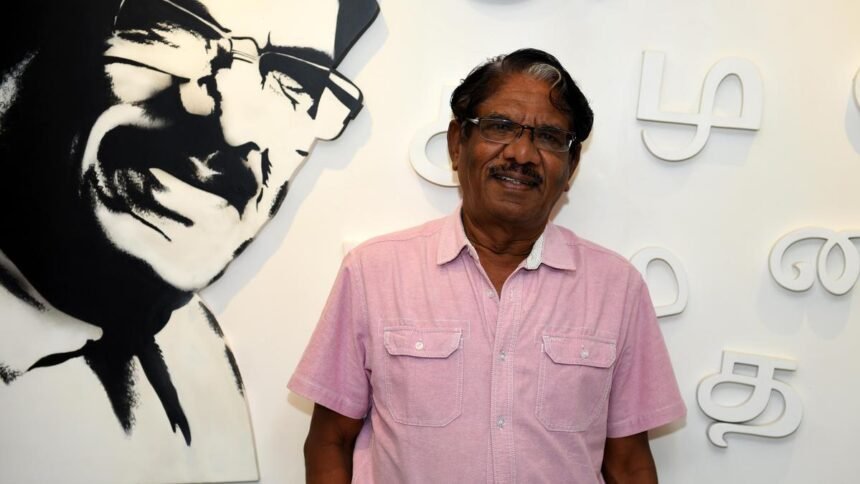
As Tamil cinema mourns the loss of master director Bharathiraja, his classic signature—”En iniya Thamizh makkale” (My dear Tamil people)—has become part of the mists of time . But those words also echo the legacy of another giant, the late ‘Captain’ Vijayakanth, who embodied the very essence of that salutation. On his second death anniversary, we remember the celluloid legacy of a true son of the soil .
The Son of the Soil
For fans across Tamil Nadu, Vijayakanth was not just an actor. He was a symbol of defiance, a voice for the common man, and a star who wore his humility as proudly as his on-screen persona. Unlike the aristocratic heroes of his time, Vijayakanth played the son of the soil. He did not dance in Swiss Alps; he toiled in the sun-scorched fields of Tamil Nadu. His stories were rooted, his characters relatable, and his anger justified.
The Birth of ‘Captain’
The moniker ‘Captain’ is inseparable from his identity. It was his 100th film, the 1991 blockbuster Captain Prabhakaran, that bestowed the title upon him . Directed by RK Selvamani, the film featured Vijayakanth as an IFS officer. But it wasn’t just the role that earned him the name; it was his active participation in the affairs of the industry as the chief of the Nadigar Sangam and his instrumental role in introducing many directors and actors that made the title stick . While his contemporaries Rajinikanth and Kamal Haasan were christened ‘Superstar’ and ‘Ulaga Nayagan’, Vijayakanth was, and will always be, known as ‘Captain’ .
The ‘Revolutionary Artist’
Before he was Captain, he was ‘Puratchi Kalaignar’ (Revolutionary Artist), a title bestowed upon him in 1987 for his film Cooliekkaran . A remake of the Hindi film Kaalia, it was a role that captured the imagination of the masses and cemented his image as the champion of the oppressed .
The Mass Hero Template
Vijayakanth understood the mass hero formula better than most. Yet, his films always carried a message. He did not just fight for revenge; he fought for justice. He was the common man’s superman—one who bled, who cried, and who never forgot his roots. His films were not just entertainment; they were a source of empowerment for the working class.
Politics and the ‘Puratchi Kalaignar’
His transition to politics with the Desiya Murpokku Dravida Kazhagam (DMDK) in 2005 was a natural extension of his on-screen persona . While his party may not have captured power, his integrity was never questioned. In a landscape dominated by two Dravidian giants, the Captain stood tall, earning the love and respect of the people through his service-oriented politics .
A Legacy That Endures
Now, two years after he left us , the industry has splintered into fan clubs for other stars, but the Captain’s fans remain a unique, sentimental fraternity. They are not just fans; they are soldiers who saw their leader fight one last battle against illness with the same grit he displayed on screen.
He may have left the building, but his voice—firm, unwavering, and full of love for his Thamizh makkale—will echo forever in the halls of Tamil cinema.