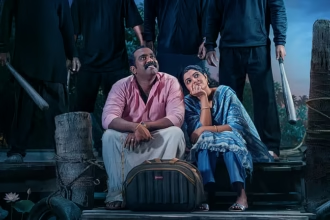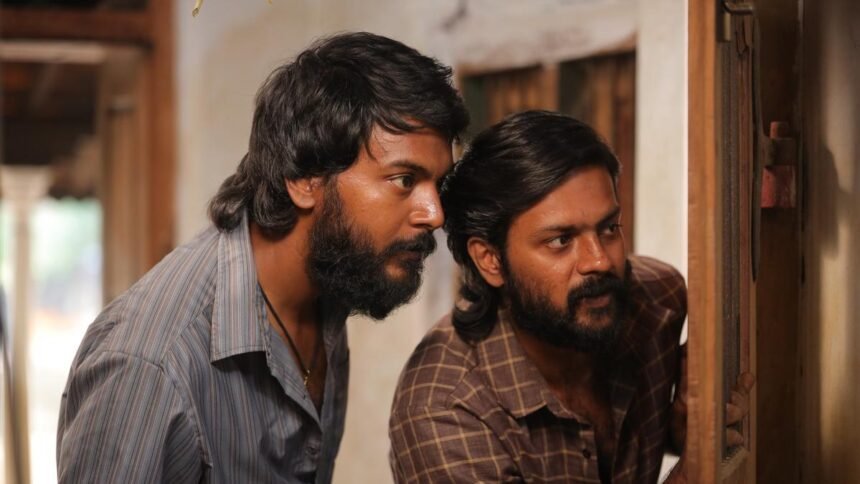
Chennai, India – In a way, Dorothy, starring Sananth, Rishikanth, and Keerthy Suresh, has exposed queerphobia in modern Tamil society even before its release. The film’s conceit is to make you believe it’s a story about two men, Karthi and Subbu, who fight over a woman, the titular Dorothy. The promo materials seem designed with this in mind, but the brilliance of Karthik’s screenplay is that, at the end of the day, even when you know there’s a queer theme, the film still tells that story in a breathtaking way.
We have Subbu (a perfectly cast Sananth), a young man who looks up to Bruce Lee and spends much of his time with his best friend, Karthi (Rishikanth steals the show). Raised as a ‘kadaikutty’ by ruffians in a womanless household, Subbu yearns for motherly love, which he first sees in Karthi’s mother and later, in his sister-in-law, Dorothy (Keerthy Suresh makes you want to see her more often). Karthi, on the other hand, starts as a young, scared boy who did not have a father to protect him and his mother from a cruel, patriarchal world. However, as life has it, Karthi grows up as someone who seems more suited to Subbu’s world, and vice versa.
At a time when incel culture is suffocating Indian social media, it’s a crucial work of writing that underlines how a heartbreak caused by patriarchy fuels this toxicity in Karthi. In fact, every crucial moment in this story is inadvertently caused by women—through her wedding, her affection, her death, or simply her existence. In a film that could be seen as a follow-up to his 2016 film Iraivi, Karthik Subbaraj looks far more mature. Through a steady buildup of character, Karthik’s script lets you experience being a feminine presence in a hypermasculine, cis-heteronormative world. He shows that women too can fight like Bruce Lee, but there is also bravery and intellect in walking away from a fight.
Karthik’s most cohesively written script, Dorothy is also his most progressive take on how caste, class, and gender intersect. The filmmaker conveys both large and small ideas efficiently; even the way a character eats parotta becomes a sentiment. And no call to nostalgia seems complete without maestro Ilaiyaraaja, whose music becomes a character itself in Dorothy. For many years, Tamil queer audiences have yearned for a queer film that reflects their lives with accurate representation.
Must Read: ‘Village Rockstars 2’ Review: Rima Das Returns with a Psalm of Resistance
Dorothy might be the start of a queer revolution in mainstream Tamil cinema. To speak in the language of hate that Dorothy seems to be attracting online, if this queerphobia is a zombie herd of ignorance and apathy, more mainstream representation of queer themes will be the flash flood of sense and scientific temper. All it took was one audacious filmmaker, a daring producer, and a passionate cast to pull off what might just become the most important Indian film of the year. Dorothy is currently running in theatres.