Chennai: DakshinaChitra, one of Chennai’s most recognisable museums, has been a school excursion staple and a Chennai darshan tourist pitstop for decades.
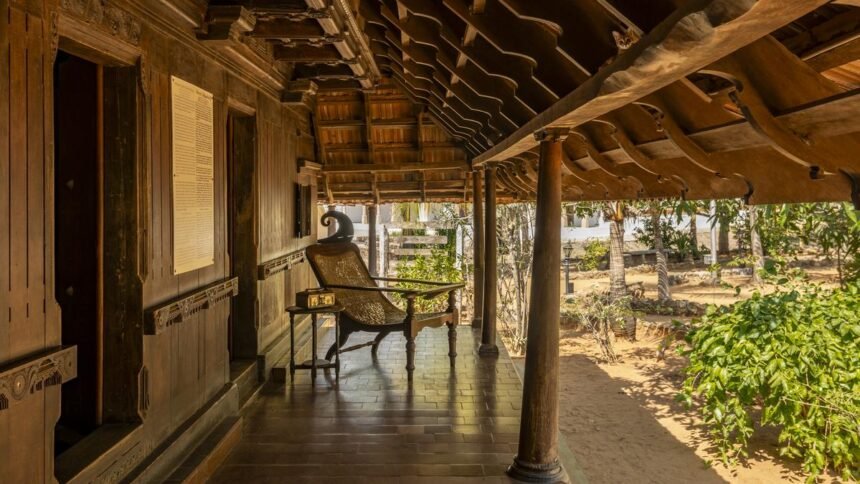
What this living-history museum has done over three decades — besides setting up its most prominent exhibit, 18 authentic historical houses — is attempt a broader, more inclusive view of the cultures of various South Indian states.
The Institution
Located in Muttukadu near Chennai, the 10-acre museum was established by the non-profit Madras Craft Foundation under art historian Deborah Thiagarajan. It opened to the public on December 14, 1996. Three decades on, the institution continues to focus on cultural preservation and heritage.
The Anniversary Exhibition
To mark the anniversary, a special exhibition has been curated at the museum.
“Over the past 30 years, artists, craftspeople, families and performing communities have generously entrusted us with objects of memory and cultural significance, donating them for public display. In this context, Crafting a Southern Canvas, the exhibition, is an ode to these remarkable contributions,” says Indumathi Mohan, senior manager, Collections, Library and Conservation.
The exhibition has been curated by a team comprising Indumathi, contemporary artists BO Sailesh, Shyamali Misra and Ritwick Ganguly. It opens with a tribute to pioneering architect Laurie Baker, whose work significantly shaped DakshinaChitra’s architectural character. Visitors can view his original sketches and architectural plans.
Other highlights include:
- Museum in Print, tracing the institution’s evolution through publications, posters and archival material
- The Contemporary Art Collection, featuring works by artists of the Madras Art Movement, including paintings by P. Perumal and Thota Tharrani, and prints by Rm Palaniappan
- Rare reverse-glass paintings, bronzes and kolu dolls donated by long-term contributors
- Paintings from the Irula, Gond and Cheriyal traditions
Alongside this, visitors can view the Heritage Trail, a photographic retrospective of the museum’s evolution. The exhibition runs until February 28, 2027.
‘A Community Museum’
Sharath Nambiar, director of DakshinaChitra, who has been associated with the institution since its inception, says he is delighted by the scale of its growth.
“Our spaces and buildings are welcoming, not intimidating. This was the vision envisaged by our founder who undertook extensive research, pursued a course in museum management and went on to design DakshinaChitra,” says Sharath.
“Over the years, we have dispelled the perception that we are an elitist institution. Today, we have evolved into a community museum and a space for everyone. It is particularly heartening to see more young people visiting.”
The museum welcomed 2,50,000 visitors this year alone. “Our target is to reach 3,50,000 annually over the next couple of years, and 5,00,000 in the next five to 10 years,” he says.
Looking Ahead
To mark 30 years, the museum is dedicating a building to traditional musical instruments of South India. The Ministry of Handicrafts has donated a significant collection.
“The construction of this three-storey musical park is set to be launched in the coming weeks. The space will promote the classical arts and music of South India through performances, workshops and demonstrations of traditional musical instrument-making,” says Sharath.
The management also plans to revamp some permanent exhibitions that have been in place for three decades. The exercise will begin with the Kerala koothatukulam house, followed by a new exhibition at the Chettinad house centred on the Sangam period. Both are expected to be completed by April 2027.
“We are planning to establish a creative centre with office spaces, meeting rooms, a theatre, studios and a seminar hall for screening art films. The centre will incorporate the latest technologies and AI innovations to upgrade some of our exhibitions,” says Sharath.
The Commemorative Book
Launched to mark the anniversary, The Journey of an Idea is a commemorative publication chronicling the evolution of Deborah Thiagarajan’s vision into one of South India’s significant living museums. It celebrates the people, communities and collective efforts behind the institution while documenting the traditional architecture, craftsmanship and cultural heritage of the five southern states. The book is available at dakshinachitra.net.