Anurag Kashyap does not make comfortable films. That is the reason his admirers admire him and his detractors cannot ignore him. But with ‘Bandar’, the director has crafted something that unnerves not by what it shows, but by the questions it refuses to answer.
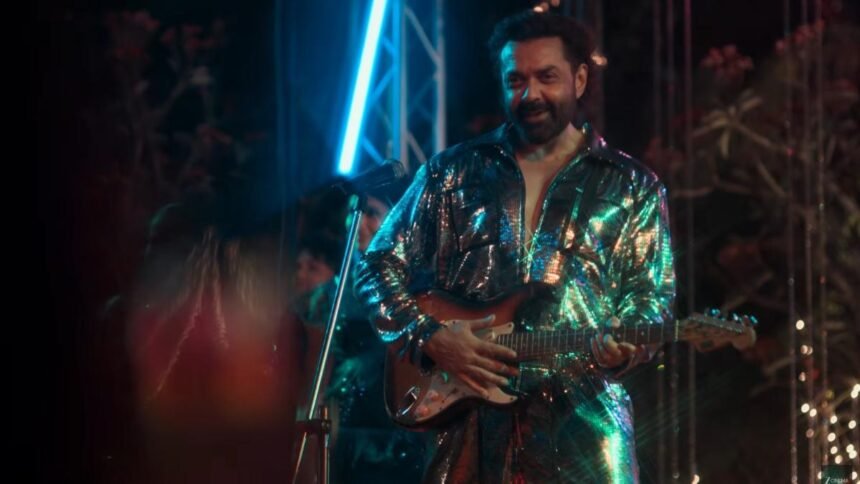
‘Bandar’ (Monkey) follows a fading movie star, Baba (Bobby Deol), whose decade-long reign at the top has ended. His son has no interest in his legacy. His wife (Chitrangda Singh) has withdrawn into icy silence. And a young actor (Saba Azad) has accused him of rape. The film is not a whodunit. We never see the assault. We never hear the accuser testify. The film is not interested in her story. It is interested in how Baba’s world contracts—how the predator becomes prey, how the star becomes a spectacle, how the cage door closes but never fully locks.
Bobby Deol’s most dangerous performance
Bobby Deol, who has been enjoying a second-act renaissance, does something here he has never done before: he makes us uncertain. His Baba is not monstrous in the way of a clear villain. He is wounded, confused, and deeply, terrifyingly ordinary. He doesn’t rage; he mumbles. He doesn’t scheme; he freezes.
There are sequences where he sits alone in a green room, watching his old films on a tablet, mouthing the dialogues along with his younger self. The camera holds his face for minutes. He does not cry. He does not shout. He simply exists in the wreckage of a career built on roles where he always won. Watching him is uncomfortable because the film refuses to tell us how to feel.
The Kashyap blueprint
Kashyap’s signature flourishes are here in abundance: long unbroken takes, moody lighting, a soundscape that buzzes with unease. The hotel corridors where the accused is confined become labyrinthine monuments to self-pity. The colour palette is drained of warmth.
But unlike his best work—‘Ugly’, ‘Gangs of Wasseypur’, ‘Raman Raghav 2.0’—the technique overwhelms the substance here. ‘Bandar’ is never boring, but it is often exhausting. The film performs self-reflection without delivering it.
The mirror that is not there
The film’s central metaphor is its title. Baba paces his cage, agitated, watchable, but never truly introspective. We see him isolated. We see him pitied. We see him mourned by fans who hold candlelight vigils outside the police station. But we never see him look in a mirror and recognise the person staring back.
This is where ‘Bandar’ frustrates. By refusing to give its protagonist a moment of genuine reckoning, Kashyap risks making a film about nothing more than style. The technical accomplishment is undeniable—the cinematography, the sound design, Deol’s physical commitment—but style without moral weight is just performance art.
Who this film is for
Fans of Kashyap’s aesthetic will find much to admire. Those seeking a straightforward #MeToo thriller will be disappointed. The film has already sparked debate about whether it humanises an accused man without holding him accountable, whether it is brave or cowardly to refuse judgment.
Perhaps that is Kashyap’s point: art should not tell us what to think. But ‘Bandar’ errs in the opposite direction, leaving so much unsaid that the silence starts to feel like evasion rather than invitation.
The verdict
‘Bandar’ is not a failure. It is a near-miss—a film with the courage to ask difficult questions but not quite the nerve to answer them. Bobby Deol carries it on his slumped shoulders, delivering a performance that haunts long after the credits roll. But the film around him, for all its technical bravado, stays stubbornly on the surface of its own dark ideas.
Anurag Kashyap has made films that burrow under the skin. ‘Bandar’ scratches the surface, draws blood, and then walks away without dressing the wound.