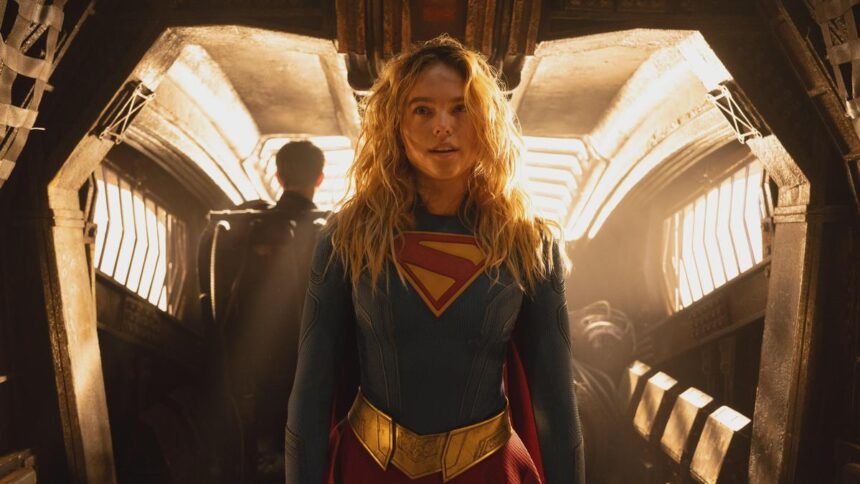
Craig Gillespie’s adaptation of ‘Woman of Tomorrow’ strips Supergirl of everything that made her worth adapting, exposing a rebooted DC Universe already repeating its own mistakes
Last year, James Gunn’s Superman tried to rebrand the most straight-laced, goody-two-shoes superhero in pop culture as “punk rock.” Now, Craig Gillespie’s adaptation of Tom King and Bilquis Evely’s celebrated 2021 comic Supergirl: Woman of Tomorrow introduces the one major DC character who actually possesses a recognisably punk sensibility, only to sand away almost every abrasive edge that made her compelling on the page.
This is the second theatrical entry in the rebooted DC Universe overseen by James Gunn and Peter Safran, following Gunn’s take on the Man of Steel. Instead of committing to Kal-El’s Kryptonian super-cousin Kara Zor-El as the traumatised cosmic drifter whose anger exists in permanent dialogue with impossible ideals of heroism, Supergirl reduces its eponymous hero’s first feature-film outing to the same faux-anarchic house style sludge that has metastasised across every superhero film touched by Gunn since Guardians of the Galaxy.
What the film gets wrong
The film follows Kara, played by Milly Alcock, who survived the destruction of Krypton with memories fully intact, unlike her infant cousin Kal. She celebrates turning twenty-three by hauling her super-dog Krypto across an interstellar pub crawl on planets orbiting red suns, exploiting the one astronomical loophole that temporarily deprives Kryptonians of their powers.
The premise immediately distinguishes her from Superman, whose unbridled optimism stems from his ordinary upbringing in Kansas. Kara instead carries lived memories of cultural extinction that continue to haunt her. Ana Nogueira’s writing gestures towards that interiority through a flashback sequence, yet every revelation is just further spoon-fed exposition.
The screenplay’s inability to organise Kara’s inner life inevitably weakens every relationship orbiting her. The film pairs her with Ruthye, an adolescent girl played by Eve Ridley whose parents and brother are butchered by the space pirate Krem of the Yellow Hills. In the original comic, Ruthye served as our point of entry into the story, recounting Kara’s actions years later, transforming the journey into an examination of heroism itself. This adaptation shifts the narrative almost entirely into Kara’s perspective without constructing an equally compelling interior framework to replace it.
Milly Alcock’s performance
Alcock largely escapes the wreckage because she seems to intuitively understand Kara beyond whatever the writing fails to articulate. Every exhausted shrug or sarcastic deflection, and every fleeting moment where Kara’s guilt punctures her cultivated indifference, suggests that the Australian actor constructed the emotional continuity independently of the material surrounding her.
Almost everybody else of any consequence, including a forgettable turn from Jason Momoa as Lobo, is pure collateral damage.
Visual and tonal problems
The production’s drab visual identity proves just as dispiriting. Gillespie previously translated the damaged interiority of protagonists like Tonya Harding and Estella into a distinctive cinematic language. Almost none of that survives here. Supergirl is suffocated with dull, digitised textures across anonymous LED volume horizons and interchangeable alien settlements that appear assembled from recycled concept art.
Gunn did not direct Supergirl, though his creative DNA has become so deeply institutionalised within the rebooted DC Universe that his fingerprints remain visible across almost every other major creative decision. Each aggressively curated needle-drop and every wisecracking grotesque recalls sensibilities that once felt idiosyncratic in his work at Marvel before endless repetition has since transformed them into egregious templates.
The political void
The film’s political imagination is almost as impoverished as its visual one. Every supposed act of feminist conviction or self-determination feels sterile and focus-tested. Replace Kara with almost any interchangeable female supe, and remarkably little about its performative empowerment would change. It possesses no discernible worldview beyond the exhausting blockbuster ritual of congratulating itself for discovering that women can also anchor billion-dollar consumer products.
The verdict
The review concludes that the film embodies exactly the kind of aesthetic monoculture Martin Scorsese warned was swallowing mainstream cinema and is simply the latest casualty of that cultural regression. Supergirl is currently running in theatres.