Virat Karrna suits his part well and the Telugu film is visually arresting, but it cannot make up for its divisive core
Late filmmaker Kodi Ramakrishna’s fantasy dramas of the 90s and 2000s, from Ammoru to Devi Puthrudu and Anji, remained clear in their intentions. While they were essentially good-versus-evil stories, mythology served as the basis for these films, anchored by a strong emotional core.
Nagabandham, the Telugu film helmed by Abhishek Nama, is cut from a similar cloth. The idea of good here is replaced by dharma, and the protagonist is imagined as a manifestation of the Almighty, who stands up for his community. It is a clear product of prevailing socio-political sentiments equating a region with a single religion.
The storyline
The film’s opening frames talk about humankind’s relentless pursuit of immortality and its greed for absolute power. A notorious duo, Abdali (named after the infamous Afghan invader of the 1750s) and Bairagi, are after the Brahma Kamalam, a golden flower placed alongside the deity Ranganatha in a historic temple at Srirangapuram.
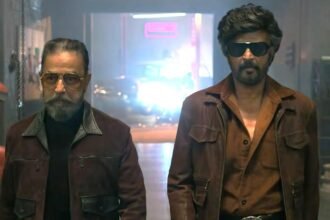
While the duo chases the artefact as its ticket to ultimate glory and power, Rudra (Virat Karrna) goes all out to protect it from them and safeguard its sanctity. Violence inflicted on a group of religious followers, with a flashback dating back to 1756, serves as the trigger for the protagonist to unleash his anger on the antagonists.
The good and the bad
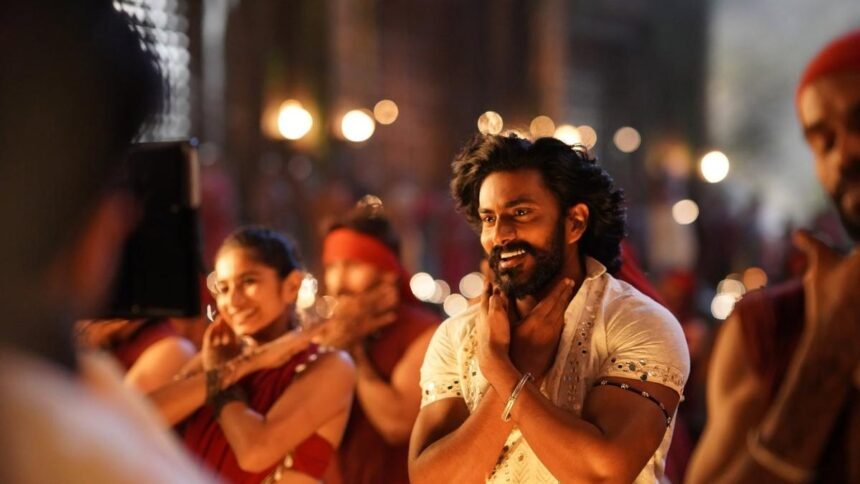
Nagabandham begins fairly well with the backstories around the various devotional elements in the narrative. There is an air of grandeur in the staging of the ‘Namo Re’ number. The stunning production design, well-lit frames and arresting choreography are exactly the sort of spectacle viewers look for in a theatrical entertainer. The narrative soon takes the form of an action adventure as Rudra battles snakes, eagles and crocodiles.
However, such small joys are short-lived as the true colours of the film emerge. The songs turn into little more than a showcase of the film’s scale, while the narrative goes too far in projecting the leading man as a protector. A Mumbai import of a villain, speaking horrendous Telugu, is brought in to challenge him.
The problem
Like in several masala films, the women look up to men as their saviours. Heads keep flying in all directions, people are burnt alive, and bloodstreams flow tirelessly. The women, from Rudra’s sibling Manasa to his mother and love interest Parvathi (Nabha Natesh), are reduced to pawns in a game played by the ever-angry, hyper-masculine men.
If the pre-interval action sequences feel tiresome, the second half only gets worse. The narrative is packed with gore and provocative dialogues bordering on communal hatred. The film’s intentions are apparent in the way it consistently uses saffron and green as religious symbols, and how a rage-filled Rudra is visualised as a torchbearer of the anger simmering within a community.
The repeated attacks on women and children, merely to depict the antagonists as bloodthirsty, vile men, is repulsive. More than storytelling merit, the film relies on VFX and action sequences. The men are on a killing spree, and it gets worse in the nearly 200-minute runtime.
Performances
Virat Karrna’s physicality and gait are assets in his portrayal of Rudra across multiple timelines. The film does not permit any trace of vulnerability in his characterisation though. Both the leading ladies, Iswarya Menon and Nabha Natesh, are expected to dress well for the occasion in traditional attire and get no scope to prove their worth.
Murali Sharma brings authority to his act as a temple priest, but other familiar names, including Anasuya Bharadwaj, Saranya Ponvannan and Mahesh Manjrekar, are wasted. Rishabh Sawhney feels miscast as an antagonist. Jagapathi Babu is regal as a veteran archaeologist.
Technical aspects
Veteran lensman Soundar Rajan’s experience comes in handy, even as the slow-motion shots and the VFX-heavy execution remain distracting. Songs composed by Junaid Kumar and ABHE in the first hour are foot-tapping, while the background score feels like cacophony.
The verdict
For all the effort that has gone into Nagabandham‘s larger-than-life visual appeal, its core is disappointing. Like several recent films across languages, it works as a clickbait film, conveniently milking a period of communal tension and cashing in on the country’s volatile political climate for easy returns.