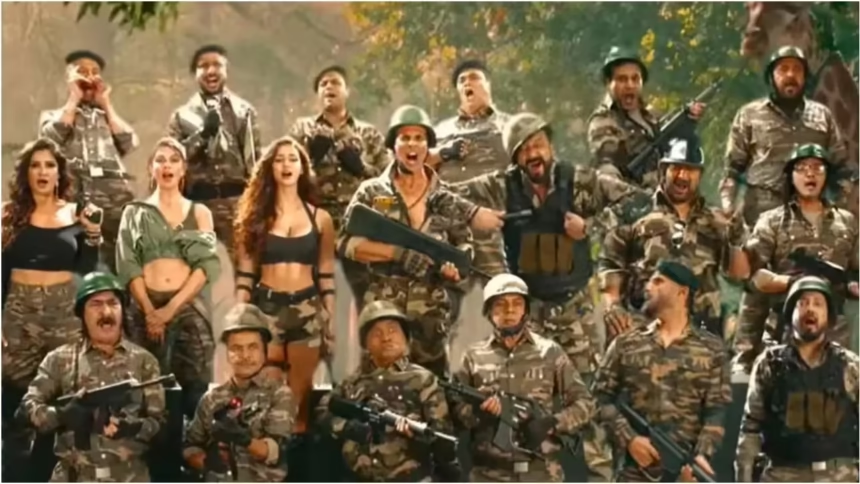
Welcome To The Jungle is yet another invitation to a cinematic universe that assumes a bigger budget and a massive star cast equal bigger laughs, as director Ahmed Khan treats the third installment of the popular franchise like a 164-minute variety show rather than a cohesive experience.
Based on late Neeraj Vora’s meta-story, it begins as a clever, self-aware critique of the film industry, where a corrupt corporate figure (Zakir Hussain), pushed by the changing political climate, decides to fund a guaranteed box-office flop to launder money. However, instead of exploiting the inherent situational irony of this film-within-a-film scam, writer Farhad Samji buries the narrative urgency under his characteristic, low-effort rhyming dialogues and disjointed sketch comedy and leaves it to Akshay Kumar and Johnny Lever to keep it afloat through their sheer improvisational brilliance.
What the film is about
Lever plays the pointsman of the business magnate who loses his voice in anxiety. He hires two floundering directors (Paresh Rawal and Rajpal Yadav) to cook up a story with a fading star, Rajeev (Akshay Kumar), and cast his erstwhile love interest (Disha Patani) as the heroine, and the producer’s daughter (Jacqueline Fernandez) for the oomph factor. Suniel Shetty and Arshad Warsi step into the shoes of Nana Patekar and Anil Kapoor as the rogue elements who want to play heroes in the film.
When the inside-Bollywood jokes saturate, Khan shifts the base of the shoot to a village in Pakistan-Occupied Kashmir, called Azad Nagar, where a terrorist (Jackie Shroff) is behaving like Gabbar Singh. In a pun on the guerrilla-style shooting, it leads to a meta showdown between the filmy Khiladi and Zatara.
What works
The film finds its true comedic heartbeat when Khan plays on the image of actors to evoke humour, transforming the massive ensemble from a casting burden into a self-referential playground. Nobody is spared. In a pun on the actor’s prolific box office choices, Akshay plays a fading star desperately seeking a second innings. The film crackles with anticipation as Raveena Tandon walks into the frame with Akshay, rekindling the embers that have been simmering since the 1990s.
The tragi-comedic dynamic between Farida Jalal and Kiran Kumar serves as the film’s layered subtext. It functions as a sharp, satirical commentary on how the larger, modern society fundamentally mishears, misunderstands, and mocks Muslims. By having Jalal speak untranslatable gibberish that only Kumar can decode into chaste, superficially elegant Urdu, Khan crafts an allegory disguised as a laugh-out-loud gag.
What doesn’t work
The blatant use of the green-screen aesthetic strips the jungle of texture and danger. The action set pieces feel unwritten—read as if the writer has prescribed “insert 10 minutes of generic chaos here” and “five minutes there.” After a point, the scale becomes an exhausting distraction.
When Khan pushes his ensemble into absolute overkill and unchecked overacting, the delicate balance of slapstick comedy gives way. Instead of eliciting organic laughter, the film begins to demand it aggressively. The moments are engineered as a collection of 30-second conceptual hooks designed to trend on social media. Though CBFC scissors have a role to play as well, it seems the makers are more interested in creating viral Instagram reels to generate buzz than in building a substantial story.00000000.