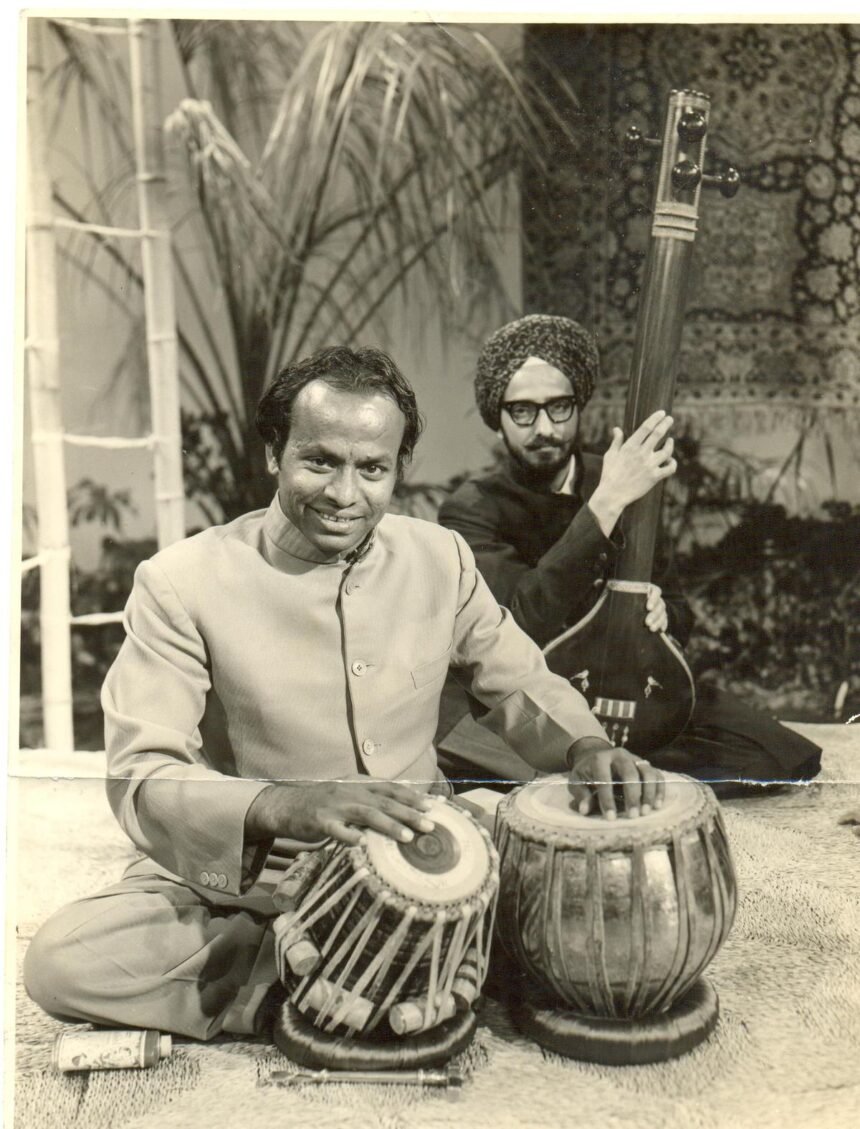
Long before Ustad Zakir Hussain took the tabla to the world’s biggest concert stages, another percussionist was already breaking down doors in the West. On his birth centenary, we remember Pt. Chatur Lal — a trailblazer whose luminous but tragically short career introduced the tabla to unfamiliar audiences and changed the course of Indian classical music forever .
From Udaipur to the World Stage
Born in Udaipur on April 16, 1925, Chatur Lal came from a family of court musicians and farmers . After moving to Delhi in the 1940s, he joined All India Radio as a staff artiste in 1947 . Everything changed two years later when Pandit Ravi Shankar was appointed as the Director of Music at AIR. Their friendship and musical chemistry soon forged a partnership that would conquer the West .
The 1955 Breakthrough
The pivotal moment came in 1952. Violin legend Yehudi Menuhin visited India, heard Ravi Shankar and Chatur Lal play, and was completely transfixed. Years later, Menuhin recalled, “That was music-making I could have only dreamed of” .
When Menuhin invited Shankar to New York in 1955, Shankar couldn’t go. Instead, he sent his brother-in-law, sarod maestro Ustad Ali Akbar Khan, along with Chatur Lal .
The duo created history by recording the first-ever LP of Indian classical music produced specifically for Western audiences, released by Angel Records (EMI) . They performed at prestigious venues that had never before hosted Indian music — the Museum of Modern Art (MoMA), the Rockefeller Centre, and even appeared on Alistair Cooke’s Emmy-winning show Omnibus .
The Jazz Jugalbandi and a Grammy-Oscar Connection
Never one to shy away from experimentation, Chatur Lal collaborated with jazz legends. While in New York, he performed a jugalbandi (duel) with swing-era jazz drummer Papa Jo Jones — perhaps the first-ever fusion concert of its kind, later popularized by Hussain and John McLaughlin’s Shakti .
His contribution also reached the silver screen. Along with Ravi Shankar, he was nominated at the Oscars in 1957 for the Canadian short film A Chairy Tale. The film went on to win a Special BAFTA Award the same year .
In 1962, he performed for Queen Elizabeth at Rashtrapati Bhawan after she requested Jawaharlal Nehru to arrange a meeting, having missed his concert in London the year before .
What the Legends Said
Chatur Lal’s untimely death on October 14, 1965, cut short a rising career at its peak. But his legacy resonated deeply with the giants of Indian classical music.
- Ustad Zakir Hussain remarked, “I believe he travelled abroad with Ustad Ali Akbar Khan in 1955. That might have been one of the earliest international tours by an Indian classical percussionist” .
- Pt. Jasraj noted, “In the past, Chatur Lal ji did what Ustad Zakir Hussain did in our time — bring tabla to every household” .
- Ustad Amjad Ali Khan called him “a trendsetter [who] elevated the tabla from something ordinary to something truly special, especially on the international platform” .
The Centenary Celebrations
The Government of India released a commemorative stamp to honour him during his centenary year, with unveiling planned for April 2026 . A grand celebration was held at Delhi’s Safdarjung Tomb, where his grandson Pranshu performed, alongside a soulful concert by Anup Jalota .
As Menuhin himself said, “Chatur Lal was one of those few supreme pioneer musicians who won for India the great and growing following it now commands in the West” .