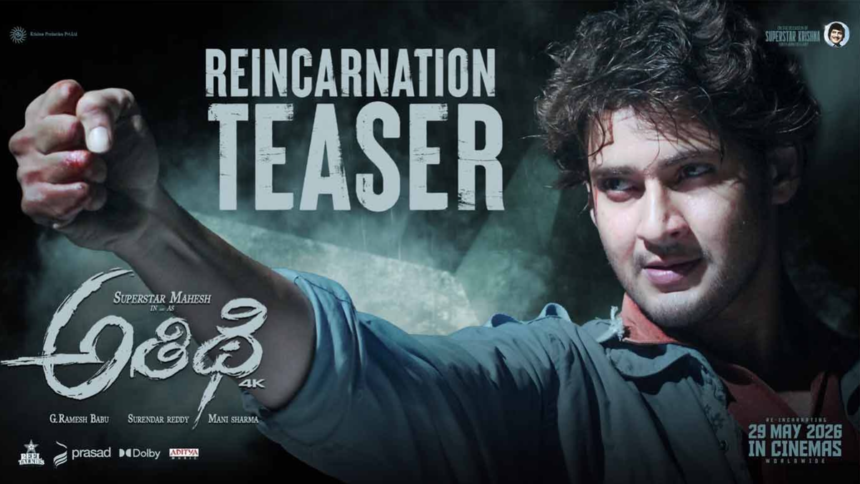
Mahesh Babu’s 2007 action drama ‘Athidhi’ is set for a theatrical re-release on May 29, marking yesteryear actor Krishna’s birth anniversary. But this is no ordinary re-release .
The film has been digitally restored and remastered at Prasad Corp, joining a growing list of archival titles being revived for contemporary audiences .
‘Athidhi’ gets a new life
What makes the ‘Athidhi’ restoration unique is that it goes beyond standard 4K upgrades. The film has been re-edited, with Mani Sharma reworking the background score .
Abhishek Prasad, CTO of Prasad Corp, notes that the quality of the original negative was “not the best we have seen, but not the worst either,” adding that “a lot of care went into the final product by the film’s team and their creative call was to make a few changes to suit the present times” .
The re-release follows a successful trend in Telugu cinema, where classics like ‘Athadu’ (which became the first Indian film re-released in IMAX), ‘Murari’, ‘Indra’, and ‘Jagadeka Veerudu Athiloka Sundari’ have drawn family audiences back to theatres .
The restoration workflow
Restoring an archival film is painstaking work. Prasad Corp follows a multi-step process: inspecting the negative frame by frame, ultrasound cleaning, chemical restoration if needed, digitisation, and then audio and video restoration using AI tools .
“If the negative is of good quality, this process takes a couple of weeks. If the film requires more work… up to 300 people work on it. It can take 1000 to 2000 man hours,” explains Abhishek Prasad .
For films missing original negatives, like ‘Jagadeka Veerudu Athiloka Sundari’, prints are sourced from exhibitors across the country .
Sound restoration challenges
The most challenging aspect is often sound. For Ram Gopal Varma’s ‘Shiva’ (1989), only mono tracks existed. CV Rao, CTO at Annapurna Studios, explains: “If you play mono in the theatre now, nobody will be interested. So we recreated all the tracks for Dolby Atmos” using AI tools to separate dialogue, effects, and music .
The process for ‘Shiva’ took four months, with RGV deeply involved in approving the recreated sound .
Preservation meets commerce
What is driving this trend? Abhishek Prasad attributes it to “the renewed revenue stream through digital streaming and theatrical re-releases” .
Earlier, monetisation options were limited to theatrical and satellite rights. Digital viewership has opened new opportunities, and post-lockdown nostalgia brought audiences back to classics, sometimes driven by fan clubs .
“This is a great opportunity for a new stream of business,” CV Rao notes. Following ‘Shiva’, Annapurna Studios has received inquiries from other production houses .
Cultural preservation
Beyond commerce, restoration efforts have significant cultural implications. The Film Heritage Foundation has restored several classics that have premiered at Cannes, including ‘Manthan’, ‘Thamp’, ‘Ishanou’, and this year’s ‘Amma Ariyan’ – John Abraham’s 1986 cult classic, restored from a single surviving print .
Prasad Corp has also restored Hindi classics like ‘3 Idiots’, ‘Munnabhai MBBS’, and the Bengali film ‘Saat Paake Bandha’ (1963) under the National Film Heritage Mission .
Future-proofing films
Abhishek Prasad urges filmmakers to scan restored films in up to 14K resolution, “even though a 4K version is sufficient for today’s television projection systems. Scanning in higher resolution helps to future proof it for another 10 to 15 years” .
As more production houses show interest in restoration, the trend appears set to grow – preserving India’s cinematic legacy frame by frame.