Ahmedabad, India – Abhishek Jain’s National Award-winning Gujarati thriller Maaran (The Hunt) is a potent and well-performed examination of patriarchy and its psychological scars. The film, which unfolds across three interconnected settings, delves into the why behind gender-based violence rather than simply the what, offering a nuanced and unsettling portrait of a society where misogyny and moral policing are normalised. While it has its flaws, Maaran stands as a significant work in Gujarat’s cinematic new wave, using the thriller genre to explore the permanence of societal rot.
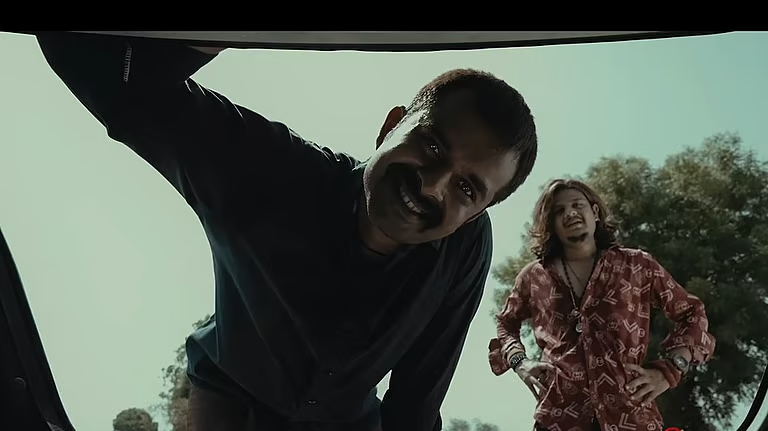
The narrative follows three threads. In an ominous village, young women are trafficked by Ratan (Yash Soni) and Babu (Shruhad Goswami). Birwa (Deeksha Joshi), a captive for five years, has developed a Stockholm Syndrome-like attachment to her abuser. Meanwhile, Ratan works as a creepy security guard in an upscale Ahmedabad colony, stalking a new resident, Tara (Druma Mehta). The third track follows Birwa’s sister, Purva (Tarjanee Bhadla), who begins to track her sibling after finding a video of her on a porn site. The film’s strength lies in its willingness to sit with discomfort, particularly in Birwa’s complex psychology—her reluctance to leave her captor, choosing a distorted “relationship” over the stigma of returning to a society that would shame her.
The film’s execution, however, is uneven. The connective tissue between the three settings is weak, with the tracks feeling like separate films clunkily merged. The film also veers dangerously close to fetishising the traffickers, offering them monologues about masculinity and moments of toxic “love.” Some sequences aim for shock value, and the spy-story elements of the sister’s pursuit feel like an afterthought. Yet, the writing is largely effective, with clever callbacks and a haunting soundtrack that reflects the characters’ mental states. Yash Soni delivers a heady mix of campy and cold as Ratan, but it’s Deeksha Joshi’s Birwa who anchors the film, reframing the “damsel in distress” as a complicated survivor who finds comfort in victimhood. The film’s commentary comes through because it remains pragmatic about the endless loop of these stories, offering no easy resolution—just the circularity of truth that seeks refuge in fiction.