Chennai: If you’ve ever happened to share a conversation with me for longer than ten minutes, chances are Godzilla has come up at least once.
My rabid preoccupation with the King of the Monsters is usually met with bewilderment at best and a barely concealed scoff at worst. Fair enough. What business does a grown man have being so emotionally invested in a giant radioactive lizard? I wish I could quantify what makes this creature inspire such an extraordinary cocktail of ecstasy, terror and outright reverence. It is the closest I have come to reckoning with a force beyond human comprehension. Perhaps I do believe in God after all. And it seems Takashi Yamazaki is among its most devoted acolytes.
The Setup
A direct sequel to 2023’s Oscar-winning Godzilla Minus One, Minus Zero picks up in 1949, two years after Godzilla’s devastating attack on Ginza. Former kamikaze pilot Kōichi Shikishima (Ryunosuke Kamiki), now married to Noriko (Minami Hamabe), is attempting to build domestic normalcy with their adopted daughter, Akiko.
Japan’s recovery is interrupted by Ghidorah, a monstrous new extraterrestrial threat. Yamazaki, returning as writer-director and visual effects supervisor, has also made the first Japanese production filmed for IMAX — the spectacle makes its predecessor look almost quaint by comparison.
Not as Perfect, But Bigger
So, is Minus Zero as perfect? The short answer is no. Its second act is often bogged down in exposition and competing character arcs, and the human drama lacks some of the narrative oomph that made its predecessor so effective.
But for almost everything Minus One accomplished, this film finds a way to go bigger, bolder and considerably more grotesque. There is something so delightfully old-fashioned (Spielbergian, even) about Yamazaki’s approach to blockbuster filmmaking.
The Human Core
The Shikishima family remains the emotional core, though their circumstances have changed. Noriko and Kōichi are now married, and the latter’s reluctance to return to combat is informed by the very real possibility of losing the family he has fought so hard to preserve.
Kamiki and Hamabe bring tremendous tenderness to these characters, even when the screenplay struggles to articulate their trajectories with the same clarity as before. Akiko carries the psychological scars of the previous attack, while Hidetaka Yoshioka returns as the eccentric Dr. Noda, now heading the government’s Large-Scale Disaster Response Bureau.
Having previously played one of Mothra’s twin fairies in 2004’s Godzilla: Final Wars, Masami Nagasawa‘s meteorologist Makoto Aoyama is a welcome addition.
The Scale
I’m frankly running out of adjectives to describe the sheer scale of this thing. There were stretches during which I genuinely forgot to breathe, and several moments when my mouth remained embarrassingly open for long enough to give Edvard Munch pause.
The creatures are so enormous, their movements so convincingly weighted, that the human beings surrounding them are but puny insects caught in the planet-levelling cross-fire. Yet Yamazaki still understands that scale is not simply a matter of making everything bigger — it’s establishing the terrifying relationship between the creature and the people forced to confront it. The camera remains insistently human-sized.
Ghidorah’s Coronation
King Ghidorah receives a suitably monstrous introduction. Initially resembling a vaguely Targaryen-adjacent dragon, the kaiju gradually evolves into its familiar three-headed, winged incarnation, eventually perching upon its new throne: the real-life Matsumoto Castle, as the city lies in ruins beneath its conquest.
Yamazaki makes inspired use of this transformation, turning the creature’s Pokémon evolution into a magnificently sinister coronation for the new king in town.
The Aerial Sequence
Much of the terror reaches its apotheosis in the film’s extraordinary aerial sequence — a prolonged exercise in weaponised anxiety that had me gripping my armrests with deeply undignified enthusiasm.
The Top Gun-style aerial choreography is immaculate, but Naoki Sato’s score is the sequence’s real secret weapon. The ominous, Wagnerian intensity of the Ghidorah motif ‘Eclipse’ gives the creature an almost operatic sense of unbridled malevolence, while ‘Narukami’, named after the ill-fated operation to destroy it, builds crippling tension with sadistic patience.
The earth-shattering bass and monstrous percussion are most definitely a public health concern for anyone sitting too close to an IMAX speaker.
The Final Confrontation
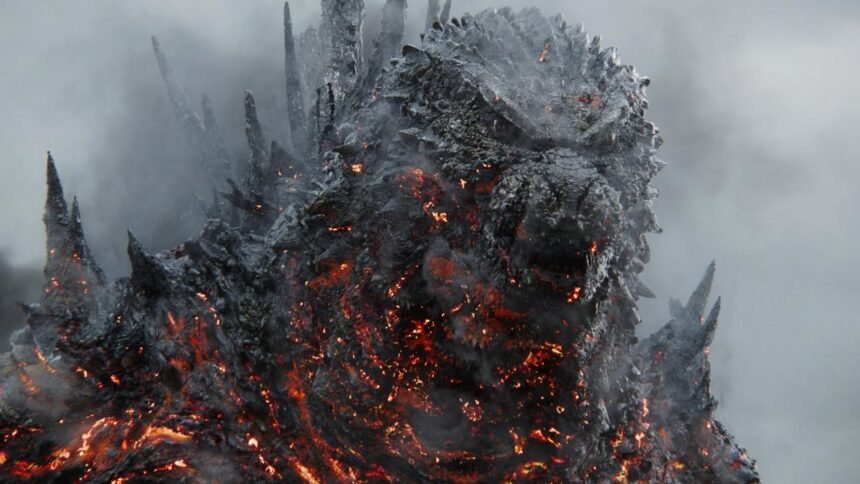
When Big G finally returns, the confrontation between the two creatures is an astonishingly vicious spectacle of atomic breath, electrical discharges, torn flesh and regenerative body horror.
There is a noticeably Neon Genesis Evangelion-esque quality to the carnage (made more delightful by Hideaki Anno’s cameo). The compositing is extraordinary, the creatures possess a startlingly tactile physicality, and even amid the most elaborate destruction, the action remains comprehensible. Godzilla also bleeds, and Yamazaki is considerably less keen on sparing us the anatomical particulars than previous instalments.
The Thesis: Hiroshima and Oppenheimer
The most interesting thing about Minus Zero is that its appetite for destruction is inseparable from its understanding of what destruction means.
The original Godzilla and Minus One were, in their respective ways, films about the catastrophic legacy of war and the repulsive absurdity of nationalism. Here, Yamazaki moves further into the aftermath. Surviving an atomic explosion does not mean escaping its consequences — there are bodies to bury, radiation to endure, children to raise amid collective trauma.
The film’s harrowing images of Hiroshima, including the charred remains of its victims, strip away whatever comfortable distance the Monsterverse iterations have otherwise provided.
Dr. Murakami
One of the film’s most compelling ideas finds expression in a new character: Dr. Kanji Murakami (Min Tanaka), a scientist whose life has been repeatedly blighted by mass destruction.
Having lost his wife and child in the 1945 Hiroshima bombing, Murakami witnesses Godzilla’s destruction of Ginza in 1947 before surviving Ghidorah’s attack on Matsumoto. His experiences as a hibakusha eventually metastasise into an especially macabre revenge fantasy.
In a brief but utterly deranged dream sequence, his subconscious summons Godzilla to New York to lay waste to the city. What follows is some of the film’s most stomach-churning imagery, as New Yorkers have their flesh seared to the bone in tableaux recalling the unspeakable opening scenes from Grave of the Fireflies. A mushroom cloud blooms over the Big Apple, the Statue of Liberty lies demolished, and Godzilla surveys the carnage with unmistakable satisfaction.
The fantasy of atomic retribution is as exhilarating as it is appalling, and the film would rather not pretend those two reactions are mutually exclusive.
In Conversation With Oppenheimer
This places Minus Zero in fascinating conversation with its fellow Oscar-winning 2023 nuclear parable, Christopher Nolan’s Oppenheimer.
Where Nolan’s self-flagellating portrait of the man who unleashed the atomic age found a remarkably receptive audience for its agonised examination of scientific guilt, Yamazaki’s sequel spits in the face of any moral discomfort the architects of the bomb felt by zeroing in on the unspeakable human wreckage their handiwork left behind.
None of this absolves Imperial Japan of the atrocities it inflicted across Asia. That historical guilt formed much of the moral scaffolding of Minus One. But Minus Zero is equally unwilling to let America’s role in the nuclear age retreat into comfortable grey areas. Yamazaki’s firm, anti-imperial rebuff to let either country’s atrocities disappear beneath the other’s is perhaps the film’s most incendiary statement.
The Verdict
I cannot pretend to be remotely objective about this franchise, nor do I particularly want to be. Minus Zero may not surpass the narrative perfection of Minus One, but it expands its world, deepens its historical anxieties and delivers some of the most exhilarating creature filmmaking I have ever witnessed.
There is something genuinely miraculous about a character who has borne witness to seven decades of being reimagined without exhausting the possibilities of what it represents. Yamazaki can take his bow. The rest of us can get on our knees, lower our heads and pay obeisance to the King of the Monsters.
Godzilla Minus Zero is currently running in theatres.