There have been many occasions when the urge to express myself fully and without remorse as a film critic had to be kept in check in the interest of editorial discretion. Such is the occupational hazard of having opinions for a living. One learns to present different versions of oneself to different people, negotiating the boundaries of what is considered permissible. Cinema criticism, of course, is inherently subjective. So, in the interest of radical transparency, I hope my editor will indulge me one rare deviation, because there is honestly no more accurate combination of words to describe You Can See Everything other than: what the actual [redacted]?
If you have spent any amount of time on the internet over the past few months, or happen to be an avid Letterboxd user, Nathan Fielder and Lance Oppenheim’s meta-documentary on the disgraced Theranos founder Elizabeth Holmes has likely crossed your timeline or your watchlist. Between the feverish critical acclaim and the sheer volume of people insisting this is one of the defining films of the century, the film has hardly been keeping a low profile. With that out of the way, I will dispense with the formalities and cut to the chase.
One of the central questions driving You Can See Everything is simple: can you actually document deception without inadvertently becoming an accessory to it? The very nature of this film seems to contradict itself and make a case for its existence. How exactly does one make a documentary, a medium whose entire claim to credibility hinges on its proximity to the truth, when its main subjects are two of the most extensively chronicled practitioners of obfuscation and manipulation? And, given that the medium itself is hardly immune to selective disclosure, can one really trust anyone to document something like this?
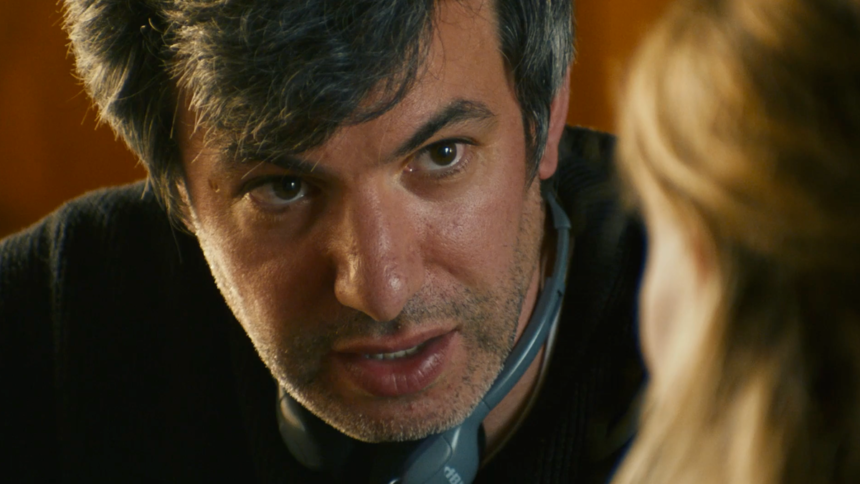
Even so, if we’re to entertain the idea of a film like this being made in the first place, Nathan Fielder is both the most fitting match for Holmes’s particular brand of freak and, given his own proclivities for pushing the ethical boundaries of unreliable narration, also arguably the worst possible candidate to document it. Having forged his television career out of elaborate social experiments and meta-documentary interventionism — from Nathan for You and The Curse to, most notably, The Rehearsal — Fielder’s affectless deadpan and pathological bluntness make him a well-suited interrogator of human delusion. Here, he sulks around corners and lurks behind doorframes like a creepy voyeur. But his most potent weapon is his mastery of weaponising awkward silences, letting the discomfort fester until someone feels compelled to break it, and seeing what they inadvertently incriminate themselves with in the process.
What makes Fielder’s method so thoroughly disconcerting is that he seems to derive inexplicable, sadistic pleasure from dismantling the social niceties of an interaction in relentless pursuit of whatever answers might emerge in their absence. Holmes is subjected to the full force of this, and Fielder assumes that controlling the camera, the questions and ultimately the narrative affords him an almost unassailable position. Except this time, Holmes is hardly one of his regular anonymous participants. Her implosion has already been documented, dramatised, litigated and picked apart, so much so that no novelty is left in exposing her. What Fielder perhaps doesn’t anticipate is that the closer he gets to his subject, the less convincing his own position as the detached interrogator becomes.
The really peculiar thing about Holmes is that she and Fielder are both clearly engaged in their own varieties of manipulation — albeit with rather different levels of self-awareness — but she, for one, appears trapped in a reality of her own manufacture, oscillating somewhere between genuine delusion and an almost Olympic commitment to dishonesty. She repeatedly insists she has never lied in her life, and doesn’t appear to consider this a particularly contentious claim. When Fielder asks whether she is being genuine, she assures him she is always genuine, yet still concedes that white lies might constitute an exception to her otherwise immaculate record.
Her relationship with the truth becomes so much more entertaining when the conversation turns to Theranos. Holmes maintains her claims about the company’s blood-testing technology were perfectly truthful, merely misconstrued by everyone else; Fielder points out that her carefully engineered ambiguity is precisely what made those claims so misleading. To illustrate the distinction, he resorts to Abbott and Costello’s Who’s on First?, only for Holmes to emerge from the exercise seemingly no closer to understanding the joke, let alone its relevance.
But though Holmes might be the ostensible reason for this entire exercise, her husband Billy Evans slowly develops an almost competitive enthusiasm for commandeering both the film and her narrative. The pre-prison domestic arrangements offer some particularly revealing glimpses of these instincts, most unremarkably when he wrests a whisk out of Holmes’s hands mid-egg preparation; while her time in prison makes him exponentially more repulsive, after smugly admitting to having mined her Twitter account for a little ego-stroking, and having the gall to brush off the grotesque implications of her AI likeness. His account of their courtship also provides Fielder juicier material to work with, and the couple’s frequent insistence that their relationship supposedly rests on undying trust and “building monuments of love” only gives him less reason to accept their word at face value.
The film’s most astonishing disclosures aren’t necessarily delivered through dialogue. Quite a few unfold in images so utterly deranged that they can only be seen to be believed. Oppenheim’s multi-camera compositions are obsessively controlled, capturing the most bizarre domestic exchanges with eagle-eyed precision. The filmmakers’ fondness for suffocatingly intimate close-ups is even more effective: Holmes’s wide-eyed, almost aggressively guileless expressions are magnified to the point where every twitch becomes an invitation to psychoanalyse against Fielder’s remarkably unyielding poker face.
And Fielder, being Fielder, has no intention of allowing reality to go about unmolested by his meta-cinematic mischief-making. As the film gathers momentum, he begins unleashing his familiar repertoire of artifice and manufactured reality, blurring whatever distinction remains between spontaneous occurrences and meticulously engineered situations. The effect is made all the more delirious by the wicked editing, constantly rearranging, withholding and juxtaposing information, as if actively relishing every ounce of our growing distrust. Some cuts made me squeal, and others made me want to tear my hair out.
But the film’s most inspired creative decision is a celebrity appearance so outrageous, so self-consciously conceived, that naming the person might defeat the point, though chances are you already know who I’m talking about. The involvement of this figure allows Fielder to indulge his ever-shameless fascination with the mechanics of performance, employing a preposterous exercise in reconstruction as a clever loophole to the supposedly insurmountable limitations of filming reality after the fact. Whether the individual is cognisant of the joke simultaneously being played at their own expense is another matter, but they gradually become a pointed exhibit in the film’s dissection of sanctimonious moral posturing, while effectively engaging in a similar kind of duplicity for which the main subject is currently serving a prison sentence. Still, the dinner-table showdown between them and Evans ranks among the film’s most riotously entertaining set pieces.
It is difficult not to find yourself feeling an uncomfortable flicker of sympathy for Holmes when the film catches her visibly distressed and sharing a home with someone so decidedly vile. But none of it ever amounts to an absolution for Holmes, nor do Fielder and Oppenheim make any concerted effort to rehabilitate her public image. They seem far too preoccupied in acknowledging how little any documentary can claim to capture, and how readily the people behind the camera bring their own prejudices into the frame.
The film saves its most vicious sucker punch for the very end, which made me thousand-yard stare at the screen. This is where Fielder executes his final sleight of hand: right when you think you’ve got him all sussed out, he exposes how little you’ve actually seen, leaving the supposedly omniscient interrogator compromised and inscrutable as the specimen he’s spent three hours dissecting. That cut to the seaside footage left my jaw on the floor for what it seemed to be implying, although whether Fielder is revealing an unguarded moment of genuine vulnerability or simply finding another way to perform one remains debilitatingly impossible to tell.
I also love how the title card is almost imperceptibly swallowed by the horizon, as though even the film’s own name is reluctant to reveal itself in full. And the emphasis you place on each word opens up an entirely different reading of its central conceit: YOU Can See Everything, You CAN See Everything, You Can SEE Everything, You Can See EVERYTHING. Four inflections, four very different suggestions.
There is an absurd amount of intellectual ammunition to unpack from this cornucopia of distrust. From post-truth epistemology, disinformation and the precarious distinction between self-delusion and shared reality, to surveillance capitalism, the ethics of the documentary gaze and the dubious proposition that visibility should be mistaken for objectivity, You Can See Everything is a gluttonous text for critical dissection. I doubt even Fielder and Oppenheim could entirely account for the strange beast they’ve assembled. It is a cinematic Rorschach test whose interpretations are likely to mutate with every revisit, and whose many contradictions should keep film scholars and cultural theorists gainfully occupied for years to come.
What is already unmistakable, however, is that this is a remarkably incisive meditation on the act of filming itself. I am reluctant to lavish superlatives on a film I am still trying to wrap my head around. However, You Can See Everything feels genuinely singular, and quite possibly like a glimpse of where nonfiction cinema could (and should) go next. I want to delude myself into believing that Nathan is keeping tabs on every last opinion and dissection the internet has produced since the film’s release. And should he somehow stumble upon The Hindu’s review of his latest masterpiece, I have one thing to say: I know what you’re feeling.
You Can See Everything is currently running in theatres.