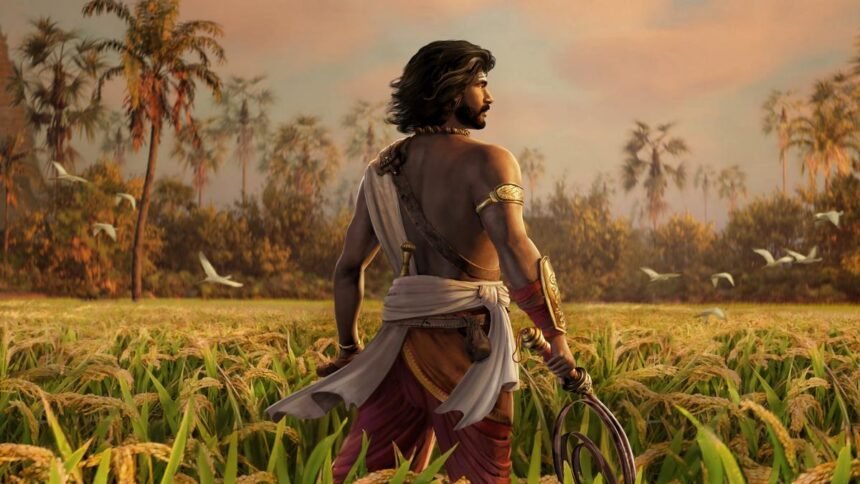
An exiled Chola prince hacks down his enemies with a whip-sword in a thrilling quest to claim the throne. Welcome to Son of Thanjai, an Xbox original open-world Tamil videogame that promises to revolutionise Indian gaming.
Ever since PlayStation and Xbox dropped the game’s now-trending promos, the attention of the global gaming community has rightfully turned towards India. Set in the 11th-century Chola dynasty, the gameplay takes place in an eight-kilometre area around the iconic Brihadeeswara Temple in Tanjore. Players step into the shoes of Vinnendhiran, a fictional Chola prince inspired by Rajendra Chola.
A 20-year dream realised
Created by Chennai-based Ayelet Studio, the game has a story, screenplay, dialogues and lyrics written by acclaimed writer and lyricist Madhan Karky. The project realises Madhan’s 20-year dream to write a video game.
“Initially, the combat designers would plan the shots. On shoot day, we capture them performing those attacks while wearing the motion-capture suits,” explains Abraham K, Studio Head and Creative Director at Ayelet Studio.
The journey began with a demo version called Unsung Empires: The Cholas, released on Steam with just a 4-member team. “When we released it, we got 75,000 downloads. Later, in 2025, we released Unsung Empires: The Cholas 2, which also got a good reception.”
Why the Cholas?
“We chose the Cholas because they’re one of the most documented kings, and we want our players to experience a new world and its mechanics,” says Abraham.
Madhan Karky explains the decision to fictionalise the story: “Whatever is documented in history was all that we’d have been able to tell. But especially because it’s going to be a different world — and a violent world — for video games, I suggested we fictionalise it.” That’s how the team created Sengazh Chola and his son, the protagonist Vinnendhiran Chola.
A world built on research
Madhan and his team researched the many elements that made up life in the 11th century. “We looked into the type of professions, stories and gossip that were documented in history. There was a document about the tunnels used during the period of Rajendra Chola, which was not documented elsewhere.”
The team also examined linguistics and iconography. “Tanjore Tamil has a dialect. For ‘dream,’ they wouldn’t use ‘kanavu,’ but ‘soppanam.’ We want Tamil gamers to understand it without needing any translations.” The game will be released worldwide in Tamil, with subtitles.
The protagonist’s journey
Vinnendhiran is “a prince spoiled by the pleasures of the world. The kingdom is falling, enemies are around, and Vinnendhiran’s mother has gone mad and is put in chains. So he’s a disturbed child, and the last in the line of the Cholas. Now, his father decides to throw him out of the palace, and that’s when the story starts.”
Players can choose their path: “He has to survive the streets, be with the people, try to see their issues, help them — or choose not to — because he always has a choice. So he is going to decide what he’s going to be,” explains Madhan.
Combat through fear and morale
The developers have introduced a concept of ‘combat through fear and morale.’ “Whenever there’s combat, the enemies would be in a 140-degree arc, and at any point in time, only one enemy will be attacking you. But we wanted to break that. So enemies will surround you in 360 degrees.”
“When you hit someone, their ‘morale’ gets affected. If you kill or target-strike someone, it affects the morale of other enemies, and they feel ‘fear.’ So the sooner you invoke fear, the easier the combat gets.”
For combat, Abraham and team opted for the South Indian martial art Kalaripayattu. “This ensures it doesn’t feel like a sword-and-shield game we have played multiple times.”
The Surul Vaal: Kalari-inspired whip-sword
Vinnendhiran’s weapon is the Kalari-inspired whip-sword, Surul Vaal. “Vinnendhiran should blend among the commoners. So we don’t want him to be carrying a sword and a shield everywhere he goes. Surul is an interesting weapon because he would tie the entire weapon around his hip and cover it with a cloth.”
The whip-sword was so fast that they couldn’t even capture it with 120 fps cameras. “We had to use a lot of hacks to track Surul’s movement.”
A living, breathing world
Every single non-playable character (NPC) has a story of their own. “Each NPC also has gossip about what’s happening in the village, as well as what’s happening with Vinnendhiran’s journey,” says Abraham.
The game also pays tribute to Sangam-era literature and music. “We have dropped Sangam-era songs written on palm leaves as collectables in different places,” adds Madhan.
Abraham stresses the authenticity of the world: “A day in the game spans 48 minutes in real-time. The interesting part is how the entire world reacts to it; for instance, when it rains during the monsoon season, the NPCs would run into shades.”
The challenges and the vision
Abraham accepts the challenges in creating a Tamil game for a global audience. “We don’t have a publisher in India to publish a game on console because we don’t have a game from India that has created a global movement. When we talk to investors outside India, they ask for references, which we don’t have.”
Madhan adds, “Whenever I go travelling, and people realise I am from India, they start talking to me in Hindi. This game is an opportunity to tell the world that there’s more to India than what they see. I love playing games in the native language because it takes me into a new world more naturally. Now, I want the world to experience Tamil culture.”
The game is planned for release in the first quarter of 2027.