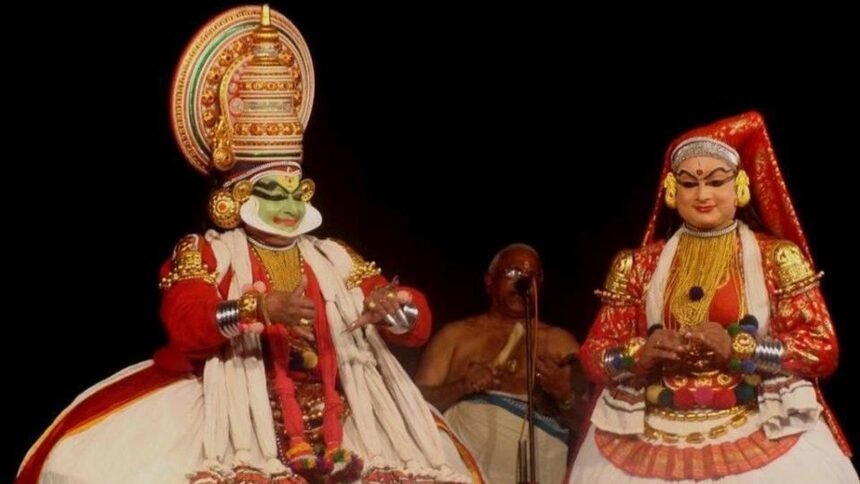
Kathakali, one of India’s most visually arresting classical dance-drama forms, is inseparable from its music. In a recent interview with The Hindu, senior Kathakali musician Madambi Subramanian discussed the deep and enduring relationship between Kathakali music and Carnatic music, the influence of Swati Tirunal, and the challenges facing the art form today.
Mr. Subramanian, a disciple of the legendary Kalamandalam Krishnan Nair, has been a Kathakali singer for over five decades. He elaborated on how Kathakali music, despite its distinct regional identity, is firmly rooted in the grammar of Carnatic music.
The core connection
According to Mr. Subramanian, the melodic framework of Kathakali music is derived from Carnatic ragas. However, the style of rendering is heavily influenced by Sopana Sangeetham—the traditional temple music of Kerala—giving it a slower, more elongated tempo compared to the faster, more structured format of standard Carnatic concerts.
“The ragas are the same, but the approach is different,” he explained. “In Kathakali, the music must serve the story. The emotions of the character—whether it’s the serene Sattvika, the valorous Raudra, or the romantic Sringara—must be evoked through the voice.” The singer’s role is to provide the emotional and rhythmic foundation for the actors on stage.
The monumental influence of Swati Tirunal
Mr. Subramanian highlighted the profound impact of the Travancore king and composer Swati Tirunal on Kathakali music. He noted that Swati Tirunal’s compositions, which blend the melodic nuances of both Carnatic and Hindustani traditions, have been integral to the Kathakali repertoire for over a century .
“Swati Tirunal’s padams are not just musical pieces; they are dramatic tools,” said Mr. Subramanian. “Their lyrical beauty and emotional depth provide a perfect canvas for the actors.” This influence continues to shape how Kathakali music is performed and taught today.
The Kottayam Thampuran tradition
Mr. Subramanian also spoke about the importance of the Kottayam Thampuran plays, which are considered among the classics of Kathakali literature. The music for these plays—Bakavadham, Kalyanasougandhikam, and Kirmmeeravadham—has a specific style that balances the demands of the story and the possibilities of the singer.
He stressed that a thorough understanding of these foundational texts is essential for any Kathakali musician, as they form the backbone of the traditional repertoire.
Challenges and the future of Kathakali music
Discussing the contemporary challenges facing the art form, Mr. Subramanian expressed concern about the erosion of quality in Kathakali music training. He noted that many musicians have shifted their focus from traditional Kathakali music to other, more financially lucrative, genres like film music.
“The art of Kathakali music requires years of rigorous training and a deep understanding of the ragas and the theatrical traditions,” he said. “We are losing that depth. While the number of Kathakali performances may be increasing, the quality of music is not always up to the mark.”
To preserve the tradition, Mr. Subramanian emphasised the need for institutional support, better training, and greater appreciation among younger audiences. He believes the future of Kathakali music lies in striking a balance between preserving its traditional grammar and making it accessible to new generations.