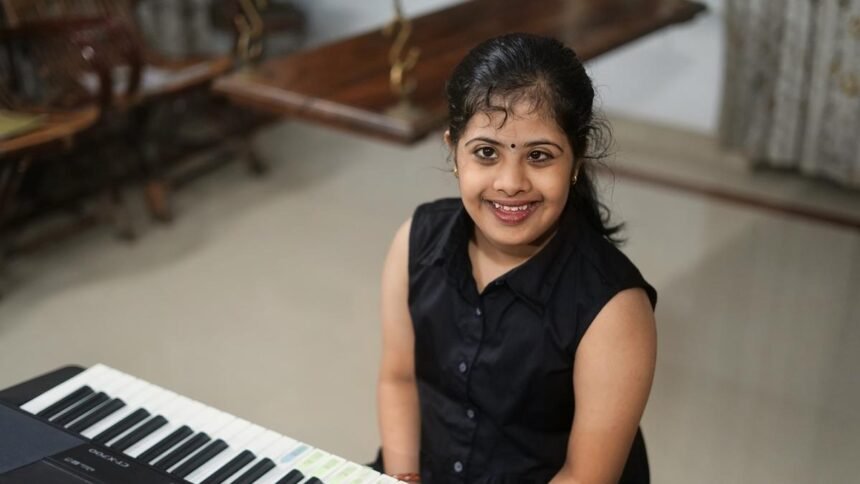
When Hiyaa Faisal sits at the piano, her small hands move with a confidence that belies her age. Watching her play, you would not guess that she has achieved what medical professionals once said might be impossible.
Hiyaa, a 10-year-old from Kozhikode, Kerala, who has Down syndrome, has mastered not one but four musical instruments — the piano, violin, keyboard, and guitar. Her extraordinary journey has earned her a place in the India Book of Records for being the fastest to identify 29 musical notes after listening to them.
A Different Beginning
Hiyaa was diagnosed with Down syndrome shortly after birth. Her parents, Faisal and Najumuddin, both in their early forties, were initially devastated. “Doctors told us she would face significant developmental delays and that complex skills like playing instruments might be beyond her reach,” her father Faisal recalls.
But the family refused to accept limitations. Early intervention therapies began when Hiyaa was just six months old. Speech therapy, occupational therapy, and physiotherapy became part of her daily routine. Progress was slow, but it came.
The Accidental Discovery of Music
The turning point came when Hiyaa was four years old. Her mother Najumuddin, a homemaker with a passion for music, would often play devotional songs on a small keyboard at home. One afternoon, while her mother was in the kitchen, Hiyaa walked up to the keyboard and began picking out the melody of a song she had heard earlier.
“I thought I was imagining it. I called my husband, and we both watched. She was playing the tune correctly. Not perfectly, but the notes were right,” Najumuddin recalls.
That moment changed everything. The family enrolled Hiyaa in formal music lessons, though finding a teacher willing to take on a child with Down syndrome was not easy.
‘She Learns Differently, Not Less’
Sumathi Krishnan, Hiyaa’s piano teacher for the past six years, admits she was hesitant at first. “I had never taught a child with Down syndrome. I didn’t know if my methods would work,” she says.
What she discovered was that Hiyaa learns differently — not less. “She has exceptional auditory memory. Play a melody once, and she can replicate it within minutes. Her challenge is not learning the music; it is with fine motor coordination. But she compensates with sheer determination.”
Hiyaa practices for two hours every day after school, broken into shorter sessions to maintain focus. Her repertoire now includes Carnatic compositions, film songs, and Western classical pieces.
Breaking the India Book of Records
In February 2026, Hiyaa attempted a feat that seemed audacious even for neurotypical musicians. In a controlled setting with official adjudicators present, she listened to 29 randomly played musical notes on the piano and identified each one correctly — by name and pitch — in record time.
The India Book of Records verified the attempt, and Hiyaa was officially recognized as the fastest person to identify 29 musical notes after listening to them.
“When we received the certificate, Hiyaa looked at it and said, ‘Appa, I want more records.’ That is her mindset. She does not see herself as disabled. She sees herself as someone who can achieve,” Faisal says.
An Inclusive Classroom
Hiyaa studies at a mainstream school in Kozhikode that has embraced inclusive education. The school provides additional learning support, extended time for examinations, and a buddy system where classmates assist her with tasks that require fine motor skills.
“The other children love her. She is the most popular student in her class,” says her class teacher, Vani Sreedhar. “They have learned that different does not mean less. In many ways, Hiyaa is teaching them more than any textbook could.”
Her classmates have formed a small fan club that attends her occasional performances at school functions. When she played ‘Saare Jahan Se Achcha’ on the violin at the Republic Day celebration this year, the entire auditorium gave her a standing ovation.
Changing Perceptions
Hiyaa’s journey has already begun to shift how disability is perceived in her community. Her parents have started an informal support group for families of children with Down syndrome in Kozhikode, sharing resources and offering encouragement.
“Other parents come to us and say, ‘If Hiyaa can do this, my child can also achieve something.’ That is the most meaningful part of this. It is not about the records. It is about changing what people believe is possible,” Najumuddin says.
What’s Next
Hiyaa has no plans to slow down. She is currently preparing for her grade 4 piano examination through Trinity College London — a standard examination taken by students without disabilities.
When asked what she wants to be when she grows up, Hiyaa does not hesitate. “I want to be a pianist,” she says, her voice clear and steady. “A famous one.”
Her father Faisal smiles. “Who are we to tell her she cannot?”