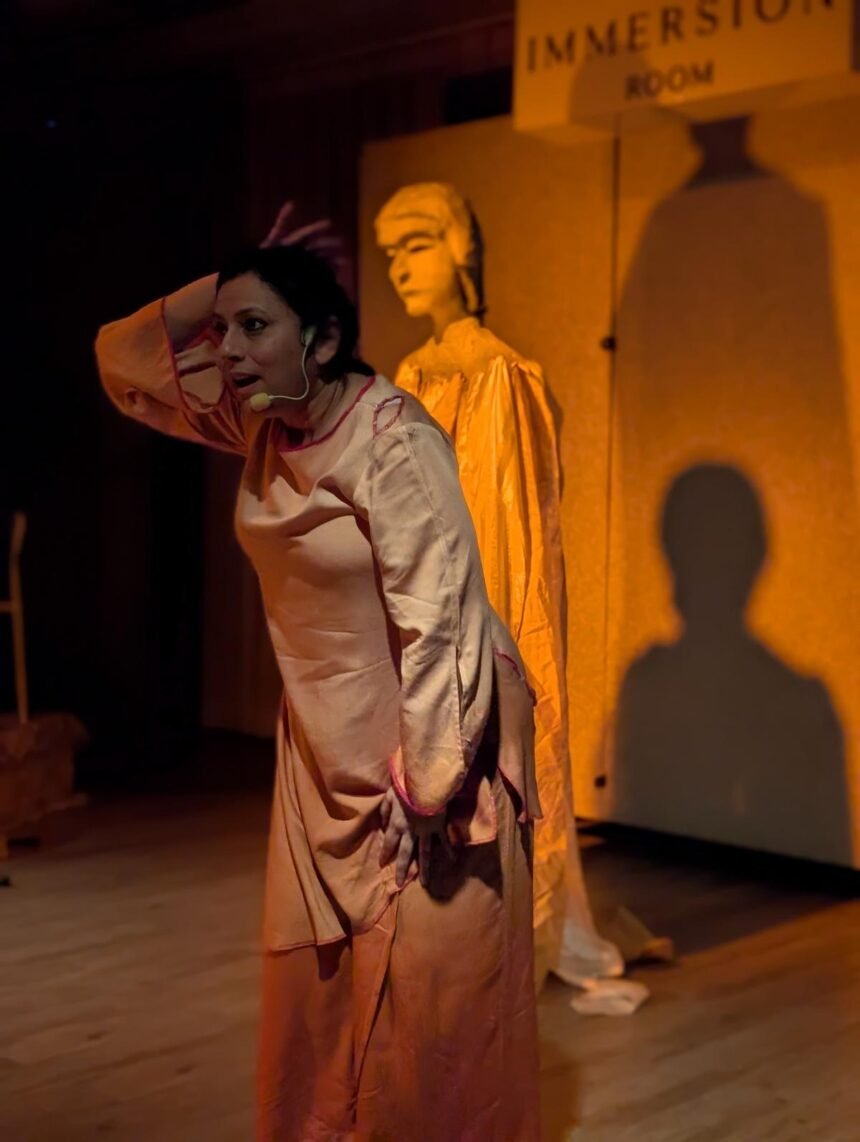
Spiral is a monologue that examines how women navigate fear, surveillance, harassment and abuse in contemporary urban India. It brings together three fictionalised narratives drawn from lived experiences that unfold across both public and private spaces.
Going by its powerful theme, Spiral has been structured as an intimate one-woman performance (Preeti Agrawal Mehta) piece to erase the divide between the spectator and the artiste. In the process, audiences are cast not merely as observers but as witnesses and confidants — occasionally confronting their own complicity within the worlds being revealed.
Drawing inspiration from the stark intensity of Samuel Beckett’s Not I , the production expects audiences to remain alert rather than slip into detached viewing.
The Format: One Performer, Multiple Characters
The solo performer inhabits multiple characters through shifts in posture, voice and movement, backed by a live musical score including piano, strings and hand percussion that shapes the rhythm of the narrative as much as the spoken word.
Designed for intimate venues and smaller audiences , the play creates a direct, unfiltered connection between the performer and those watching. There is no fourth wall to hide behind — for the actor or for the audience.
The Origin: From Observation to Creation
The idea for the play came from years of observation. Director Mohit Mukherjee explains:
“While studying at Delhi University and working in theatre, I was constantly around conversations, rehearsals, gatherings and friendships where I noticed how women often moved through the same spaces very differently from men. There was always an invisible burden they carried simply because they were women. What stayed with me even more was how little resolution or justice seemed to come out of many of these experiences.”
Wanting to respond to these realities through theatre, Mohit was aware of the limitations of telling such stories as a man. “I did not want to pretend to possess an experience that was not mine,” he added. That is why bringing a woman co-writer into the process became important.
Act One: The Public Space — Feeling Watched
The first act follows what begins as a simple run through the city but slowly turns into something deeply unsettling.
“The character feels watched, followed and constantly unsafe. Whether the threat is real or partly imagined is never fully clarified. What matters is that the fear itself is real. It is exhausting, consuming and yet strangely normalised within the experience of moving through a city as a woman.”
This act captures the constant vigilance that women in Indian cities learn to maintain — checking who is behind them, avoiding isolated streets, holding keys between fingers, sharing live locations with friends. Fear becomes a background hum, ever-present but rarely named.
Act Two: The Private Space — Violence in Silence
The second act shifts into the private space of the home , where the violence is quieter and more difficult to name.
According to Mohit: “It exists in pauses, silences and things left unsaid. The audience is placed in an uncomfortable position where they become witnesses to the emotional and physical abuse unfolding before them, while also feeling implicated by their inability or unwillingness to intervene.”
This act tackles domestic abuse — not the sensationalized version seen in crime reports, but the slow, grinding reality of manipulation, control, and emotional violence that leaves no visible scars but destroys from within.
Act Three: The Aftermath — Blaming the Survivor
The final act examines the aftermath of abuse through the flood of advice, judgement and moral policing that often surrounds survivors.
“The audiences slowly piece together what may have happened, but the larger focus remains on the social conditioning that teaches people to shame, doubt and correct rather than listen ,” said Mohit.
This act confronts the audience with their own potential complicity. How many times have we asked “What was she wearing?” or “Why didn’t she leave?” or “Why did she go there?” — questions that shift blame from the perpetrator to the survivor.
None of the stories rely on sensational dialogues or extraordinary situations. Much of what is said echoes phrases we hear in everyday life. “That familiarity is what makes the world of Spiral unsettling,” says Mohit.
The Seed: A News Report from Haryana
The seed for Spiral was sown sometime after 2020 when Mohit came across a news report about a sexual assault in a village in Haryana.
“What shook me was not only the violence itself but the response from two elderly women in the village who blamed the survivor and spoke about her clothes as if they had invited the crime. That moment stayed with me for a long time.”
From there began the research, listening and collecting fragments of stories, conversations and experiences.
The Music: Creating Constant Tension
Music has always been central to Mohit’s work. Growing up, he was deeply influenced by the scores of films such as E.T. the Extra-Terrestrial, Harry Potter, Inception, Black Panther and Oppenheimer, and by composers such as John Williams, Hans Zimmer and Ludwig Göransson.
“Whenever I imagine a narrative, music is usually the first thing I hear. I begin by thinking about the emotional rhythm of the piece. Then come the questions of instrumentation, live or recorded sound and whether the world needs a vocalist.”
For Spiral, the music never allows the audience to fully relax. Deepak on the drums and cajón, alongside Ashim on the handpan, create an atmosphere of constant tension and unease. Yusra’s Hindustani vocals bring a haunting sense of pathos to the play, while Anil Chawla on the keys moves seamlessly across pop, rock, jazz and Hindustani folk to complete the ensemble.
Further, one of India’s leading puppeteers, Shameem’s contribution to scenography, puppet design and shadow work adds depth and texture to the production.
Post-Show Discussions: Theatre as Catalyst
Each performance is followed by interactive discussions that encourage audiences to reflect on issues of gender, safety, voyeurism, complicity and social conditioning.
“These post-show discussions come from a simple belief that there is little value in telling stories if they remain confined to theatre spaces alone. If we only witness injustice without questioning or intervening, we slowly become complicit in the systems that allow it to continue,” he said.
The project’s long-term vision is to continuously adapt and expand, incorporating stories, responses and experiences gathered through participatory workshops. “Because the questions Spiral engages with cannot remain static.”
The Play Factory’s Previous Work
One of The Play Factory’s earlier productions, The Patriarch , explored a business family in Kolkata through three generations of men and was co-created with Samira Gupta.
They later created ONE BHK , which looked at the life of a working woman in an urban city and drew deeply from Samira’s lived experiences.
Spiral continues this tradition of intimate, socially engaged theatre.
Why Spiral Matters Now
In a moment when conversations about women’s safety in India are at the forefront — following high-profile cases, social media movements, and political debates — Spiral offers a different kind of intervention.
Not a protest. Not a policy paper. Not a hashtag.
A theatre performance that asks audiences not just to watch, but to witness. Not just to feel, but to question. Not just to sympathize, but to act.
By placing a single woman on stage, inhabiting multiple characters, voices, and experiences, Spiral reminds us that the stories of harassment, abuse, and survival are not abstractions. They are lived realities — repeated daily, across cities and homes, across classes and generations.