How two sisters from Norway used music to navigate displacement, patriarchy, and identity—and finally found their audience in Chennai.
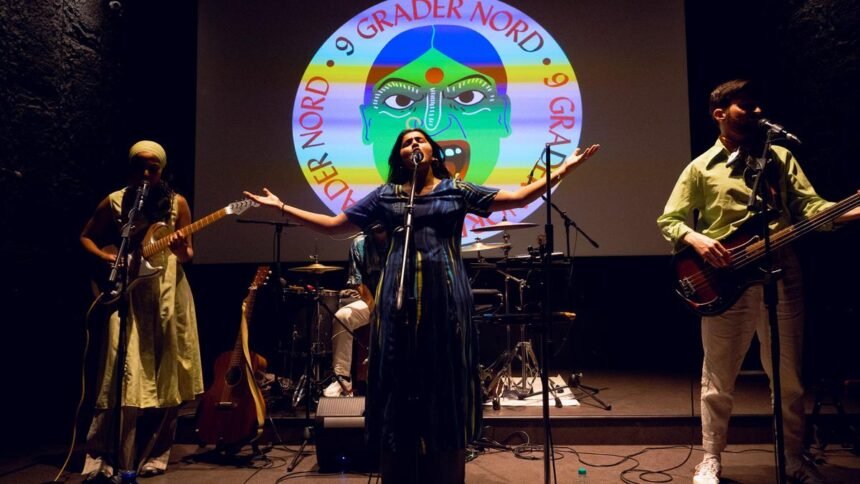
On a quiet January evening in Chennai, on the rooftop of a building in T Nagar, something extraordinary happened. An intimate crowd of just 10 to 15 people gathered at Aura Studio as Dipha Thiruchelvam, lead singer of the Norwegian Tamil band 9 Grader Nord, opened the set with a deep, soulful rendition of ‘Hymn.’
What followed was a homecoming decades in the making.
Who Are 9 Grader Nord?
9 Grader Nord (meaning “9 Degrees North”—the coordinates for Jaffna, Sri Lanka) is a folk-rock band formed in 2017 by sisters Dipha and Mira Thiruchelvam, along with Jakob Sisselson Hamre (percussion) and Jakob Sønnesy (bass guitar). Their music is a unique blend of Carnatic music, baila, and Tamil folk, woven with rock elements.
The band’s very name is a tribute to their parents’ homeland. Their mother and father fled Sri Lanka during the civil war in the 1980s and settled in Norway, carrying with them the memories and culture of a place they could no longer call home.
Art Born From Displacement
For the Thiruchelvam sisters, music is not just performance—it is a tool to express grief, assert identity, and challenge patriarchy. Their two albums reflect this deeply personal mission:
- Jaffna (2019): Their debut album, exploring themes of longing and belonging.
- Yalpanam (2023): Named after the uncolonised name for Jaffna, this album won the prestigious Spellemannprisen—the Norwegian equivalent of a Grammy—in the Open Category.
Songs like Adayalam deal with the loneliness of being a minority, while Vayppu captures the experience of arriving in a new country and unknowingly becoming subject to systemic oppression. Viduppu explores young girls figuring out their dual identity, and Victoria is an anthem of women’s empowerment.
Learning Music Through Loss
The sisters are largely self-taught musicians, and their journey began with their father’s unfulfilled dream. “Our father wanted to play the bamboo flute in Sri Lanka, but because of the war, his parents didn’t support him,” Dipha shared in an interview. “When he came to Norway, he wanted to teach us. Lack of access meant we had to listen to CDs and transcribe the notes ourselves. That’s how we learned music.”
Mira adds another layer to their motivation: “I was invited to play flute for male producers. The Tamil music industry is shaped by male fantasy. I wanted to express female emotions through both melody and lyrics.”
The Pressure to Fit In
Growing up in a predominantly white city in Norway, the struggle to balance two identities was constant. Mira recalls, “When I was younger, we were trying to be as white as possible—straighten our hair, etc. We were trying to suppress our Tamil roots. It’s been important not to chase trying to fit in.”
This tension between assimilation and inheritance runs through all their work. Yet, when they visited Chennai for their debut India tour, something shifted. For the first time, they chose to wear kurtis instead of saris, not feeling the need to represent themselves through attire. “The idea of being a ‘visual minority’ took a back seat,” they said.
Performing for an Audience That Understands
The most magical moment of their Chennai show came at the very beginning. Dipha innocently asked the small crowd if they understood Tamil. When a boisterous “yes” rang out, the band’s faces lit up with joy.
“It was surreal,” Dipha confessed. “To sing and see people who understand the lyrics. When we sing in Norway, people don’t know the lyrics. Half of my Tamil language repertoire is just jokes. To say a joke and have a room of people laugh… that was the best feeling for me.”
The Future: Navigating a New Path
Like all artists today, the band is adapting to a world where music is discovered through 30-second Instagram reels. After creating a full-length music video for Victoria—featuring Mira running on a mountain in a sari, swimming in the ocean—they realized the landscape had changed. For their latest song Viduppu, they made three reels instead.
Despite these challenges, the sisters remain hopeful. When asked about their next album, Dipha smiles and says one word: “Manifestation.” Mira nods in agreement.
For now, they are basking in the memory of a Chennai evening where, for once, they were not a minority, but one among the crowd—finally singing in Tamil for people who understood every word.
Key Takeaways from 9 Grader Nord’s Journey
| Theme | Insight |
|---|---|
| Migration & Memory | Their parents’ flight from Sri Lanka’s civil war is the foundation of their identity and art. |
| Dual Identity | They navigate being “Tamil enough” and “Norwegian enough” without losing themselves. |
| Musical Style | A natural blend of Carnatic, folk, and rock—not “fusion,” but simply their reality. |
| Patriarchy in Music | Mira started composing to express female emotions in an industry shaped by male fantasy. |
| Connection to Homeland | Performing in Chennai was the first time they played for an audience that understood every lyric and joke. |