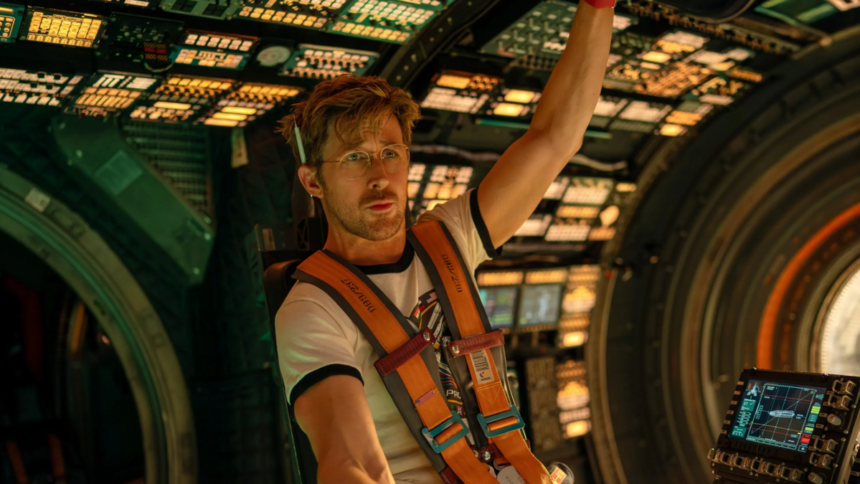
Phil Lord and Christopher Miller have done it again. The duo behind The Lego Movie and Spider-Man: Into the Spider-Verse has crafted another bright, buoyant, summer blockbuster that relishes in its nerdy delights and reminds us why going to the movies will always slap. Project Hail Mary is a rare piece of large-scale science fiction that chooses optimism without irony, anchored by Ryan Gosling’s offbeat charm and an unforgettable alien bromance.
Adapted from Andy Weir’s 2021 novel (with The Martian scribe Drew Goddard translating dense scientific prose into something legible and propulsive), the film opens with Gosling’s Dr. Ryland Grace waking up aboard an interstellar spacecraft, disoriented, half-lucid, and very much alone.
The Premise: A Science Teacher Saves the World
The microscopic threat to humanity is dubbed the astrophage or “star-eater,” pushing Earth toward an inevitable extinction-level event. Grace, a science teacher who was cornered into the mission as a last-minute replacement, must figure out why a distant star system has dodged the astrophage apocalypse that’s busy dimming the Sun and freezing Earth.
Where Matt Damon in The Martian radiated competence, Gosling maneuvers through the fumbling, bumbling, and socially awkward Grace with the power of charisma alone. He shapes Grace as a man devoid of heroic resolve, defined instead by small, reluctant choices that accumulate into something resembling courage.
Rocky: The Autistic Alien Bestie
The film’s heart lies in an unexpected friendship. When Grace spots another spacecraft in orbit, what follows is a surprisingly courteous bit of orbital flirting before they commit to a handshake—a 3D-printed alien tunnel capped by a transparent wall.
Through that pane, Grace meets Rocky, a five-limbed, rock-built creature forged in a high-pressure ammonia world, navigating entirely through echolocation. The first contact is nervy before it finds rhythm, paying ode to John Williams’ D–E–C–C–G motif from Close Encounters.
| Aspect | Details |
|---|---|
| Rocky’s Design | Five-limbed, interlocking mineral plates, forged in high-pressure ammonia world |
| Communication | Echolocation; 3D-printed physical models; Grace builds translation system |
| Dynamic | Tender neurodivergent intimacy through shared labour and literal-minded troubleshooting |
From there, the film doubles down on the mechanics of understanding. Rocky starts 3D-printing little physical models to explain concepts—turning language into Lego—while Grace builds a translation system by mapping sound to meaning. It’s one of the film’s smartest stretches because it renders communication as actual, physical work instead of sheer movie magic.
What Makes It Work
- Gosling’s Performance: He plays Grace’s clumsiness, social discomfort, and underlying decency with remarkable earnestness. In the process, he evolves into the best iteration of the internet’s “He’s Literally Me” fixation—a version that feels healthier, more outward-looking, and far more generous than its edgier predecessors.
- The Bromance: Grace and Rocky’s partnership develops through shared labour and improvised fixes. Both approach problems with a similar literal-minded troubleshooting, producing a kind of tender neurodivergent intimacy.
- Visuals: Greig Fraser makes scale feel tactile instead of abstracted. The void of space feels genuinely vast while the human body inside it always looks slightly outmatched.
- Music: Daniel Pemberton’s ethereal score bounces between operatic wonder and goofiness without overwhelming the tonal duality.
The Verdict
The runtime does show its hand in the final stretch, which keeps circling the landing strip, and the script never quite pushes beyond the comforts of a well-made studio blockbuster. But there’s an honesty to that choice that works in its favour.
In a moment where most end-of-the-world stories reflect the worst instincts of the present, Project Hail Mary sneaks in softer, more persistent ideas. Perhaps the image of Ryan Gosling in his slightly scuffed-up glasses, flashing that dogged, dumbass smile while walking along an alien shoreline with his autistic alien bestie, many light years away from home, feels like a perfectly decent reason to keep going.