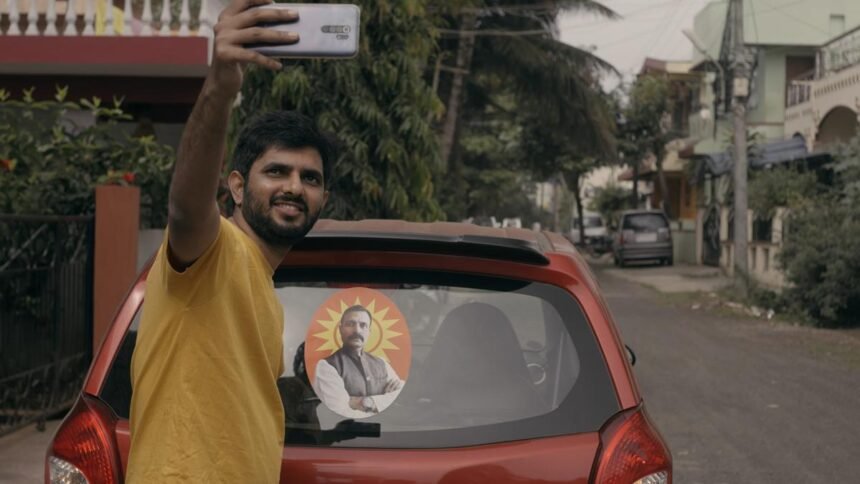
In an era of escalating online vitriol and regional tensions, director Harshad Nalawade’s Follower emerges as a powerful cinematic intervention. The Kannada-Marathi film, which recently had a special screening at Bengaluru’s Suchitra Cinema and Cultural Academy, dives into the heated border dispute between Karnataka and Maharashtra in Belagavi while tackling the messy world of social media and its impact on friendships.
The screening took place exactly a year after its theatrical show was halted by activists in Belagavi. Since then, Follower has overcome theatrical disruptions and censorship hurdles to find a home on the OTT platform MUBI.
The Story: A Fractured Friendship
Follower is a stunning drama on the long-standing border issue between Karnataka and Maharashtra. It lays bare the harsh realities of social media trolls through a moving yet realistic character study of Raghavendra Pawar (played by a superb Raghu Prakash), whose life and dreams slowly fall apart against political disputes, strained relationships, and an aimless career.
| Character | Actor | Role |
|---|---|---|
| Raghavendra Pawar | Raghu Prakash | A man who clutches onto ideology as a last resort for identity |
| Sachin | Harshad Nalawade | Pawar’s best friend; their friendship fractures over politics |
| Parveen | Donna Munshi | The third friend caught between them |
As a last resort, Pawar clutches onto ideology, as that gives him power and some sort of identity. But that comes at the cost of friendship. A clash of political opinions creates a distance between the best buddies, Pawar and Sachin. Parveen is caught between the two, trying to mend the fractured relationship before life hits her with the responsibility of being a single mother.
A Personal Film for the Director
Follower is a deeply personal film for Harshad, whose father is a Kannadiga and mother a Maharashtrian.
“The film is about a few friends of mine. I wanted to make a movie about a guy with strong beliefs. Now, if I only reflected his staunch beliefs, it would be very convenient. I wanted to understand why my friend believed in a certain leader. I wanted to know what led him to support and defend a particular ideology,” explains Harshad.
He grew up listening to Kannada songs of Dr. Rajkumar and Marathi songs of Lata Mangeshkar. “The constant language shifting was a daily scenario for me. I grew up loving both languages and always wondered why there was animosity between these two linguistic groups.”
The Echo Chamber Problem
Harshad’s analysis of the divide is sharp and nuanced:
“If a Marathi-speaking person in Belagavi is surrounded by the Marathi community, then he is stuck in an echo chamber. You want to believe what your people say. The same theory applies to a Kannada-speaking person who is surrounded by the Kannada community. This leads to the divide.”
The 100-minute film is a balanced reflection of the prevailing political tensions where the characters aren’t judged harshly but portrayed as vulnerable beings.
Censorship Hurdles
At the screening, Harshad revealed the censor board’s ironic demand to mute the words ‘Kannada’ and ‘Marathi’ in the movie.
“The board suggests cuts based on what the current government has to say or will say. People in the censor board aren’t suggesting cuts based on their intelligence. They are controlling films based on what the majority of the nation believes. It’s scary and unacceptable,” he opines.
He argues that the primary duty of the board is to provide a censor certificate, not to tell the filmmaker what to show or what not to show.
The OTT Challenge
Self-censorship on OTT platforms added another hurdle. “We approached several platforms, but they were cautious about taking such films. We are living in tricky times, and nobody wants to take risks,” Harshad notes.
Despite these challenges, Follower eventually found a home on MUBI, where it is now streaming.
What’s Next
Before making Follower, his debut feature, Harshad assisted directors such as Umesh Kulkarni and Sudhir Mishra. He has co-written the web series Killer Soup and Ghoul on Netflix. He is currently writing his second feature film, which will also be set in Belagavi.
“My stories will continue to come from North Karnataka and South Maharashtra. Mainstream cinema has portrayed people from that region in a caricaturish manner. In reality, there is so much intensity and coolness to people from that region.”