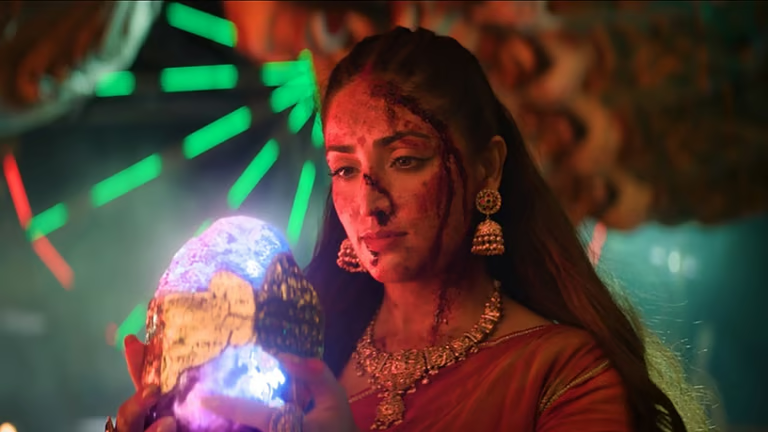
Mumbai: Nayyi Navelli arrives with the seed of a radical horror-comedy idea — and then, frustratingly, refuses to water it. Featuring Yami Gautam Dhar as a newly married woman rumoured to be a witch, the film quickly escalates from a quirky family comedy into a due-process devotional saga.
The Setup: TVF Gullak Meets the Supernatural
The first half plays out like the answer to the question: What if TVF’s Gullak was pushed into the supernatural space? There’s a quirky Meerut-based family, an ancestral home, lots of squabbling, and plenty of fondness parading as noise and taunts — plus an hour-long emergency meeting on the terrace against an artificial city backdrop.
The black sheep, Bantu, is desperately trying to convince the rest that the newest entrant in the family is a ‘daayan’ (witch); that his elder brother Raja’s wife, Mohini, is not a normal woman. It’s like watching a low-budget courtroom tale, as Bantu painstakingly offers proof, recalls weird scenes, narrates eye-witness accounts and provokes irritated family members to punch holes in his narrative — all while an allegedly possessed Mohini is locked away in a room.
A Radical Premise, Briefly
Despite the stage-play setting, the film has the seed of a radical horror-comedy idea. The women of the household credit Mohini for liberating them from patriarchal shackles. The old lady screams feminist slogans like “Burn the bra!” and “Your body, your choice!” The middle-aged aunt is no longer a spinster, thanks to Mohini finding her an IAS-officer bachelor so eligible that their recent wedding beggars belief.
They all refuse to entertain Bantu’s claims, but the evidence of her flashbacks mounts up; Mohini also leaves a trail of crippled (or dead) men in her wake. Yami Gautam Dhar is worryingly persuasive as the other-worldly Mohini. Her husband Raja is a good man who begins to doubt his own luck: why, after all, would the group-head of his company marry a mediocre minion like him? You sense the social angle: a “different” woman is scrutinised through the male gaze. So far, so Stree-coded.
The Twist and the Collapse
The twist, of course, is that Mohini isn’t who they think she is. The second half replays those same scenes from another perspective, shaming the viewer for agreeing with Bantu. But the mythological direction the film takes is consumed by its own reverence and awe — like a homegrown Dan Brown novel in search of national validation.
The film joins the recent spate of devotional mytho-dramas that insist on treating fiction as actual history. There is some gender subversion in the good-versus-evil arc, but the writing refuses to entertain it beyond a point. The monster hidden in men, a female-superhero vibe and the general misogyny in middle India are flattened into a slew of fabled, non-negotiable themes. It becomes dense, dull, preachy, and too afraid to be playful with the Ramayana — except for a musical number that demolishes Ravana’s living-dead zombies.
Mytho-Splaining the Audience
Mohini spends the second half verbally educating her husband’s family about Valmiki’s literature with a divine smile. The submit-or-else tone is strong — an accurate metaphor for how the film sees its audience: subservient, all ears, respectful, ignorant, and ready to be mytho-splained at the drop of a (holy) hat.
The central performance becomes the weakest link because the film settles for safety and self-seriousness. It’s always strange that, for an ancient culture with some of the most layered mythology, mainstream Indian cinema consistently churns out adaptations so devoid of personality. The deference is understandable — it doesn’t take much to offend one of a billion-plus restless people — but I’m not sure most creators are wired to be creative about folklore anymore.
The Verdict
Of the supporting cast, Adinath Kothare does well to make the most of Raja’s mutation; Anurag Thakur is fine as Bantu, but the brief to “Be Abhishek Banerjee” weighs down his extended screen-time. The rest (especially Mita Vashisht) have a few colourful moments, but they’re too busy being scolded and infantilised by the film for not knowing their Ramayana.
You don’t win a prize for guessing that the effigy-burning climax happens at a Dussehra fair. The long disclaimer at the beginning not only gives away the plot, it also cautions against superstition and the exploitation of faith. What follows is the irony of the modern-day Bollywood film.
Nayyi Navelli does the hard part of setting up the human-comedy vessel, only to renege on its own cheeky ambition and collapse into a lopsided star vehicle.