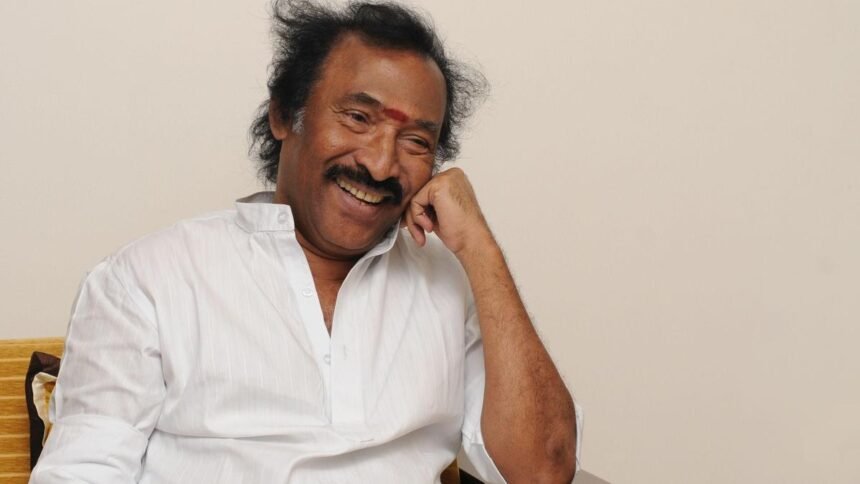
Chennai: Veteran Tamil film music composer Deva, celebrated as ‘Thenisai Thendral’ and known for his chartbusting scores in Rajinikanth-starrers such as Annamalai, Arunachalam and Baashha, passed away on Saturday (October 17, 2026). He was 75.
The Tamil Nadu government has announced that his final rites will be conducted with full State honours on Sunday (October 18, 2026).
Final Rites and Public Homage
His mortal remains are kept at his residence in T. Nagar, Chennai, for fans and film personalities to pay their last respects until 1 p.m. on Sunday. The body will then be taken to his native village of Mangadu, near Arcot in Ranipet district, for the final rites.
From PWD to Film Music Stardom
Born Devanesan Chokkalingam, Deva worked in the Tamil Nadu Public Works Department before entering films, debuting with Mattukkara Mannaru (1986). Though the film failed at the box office, its songs later gained popularity. Vaikasi Poranthachu (1990) brought him wider recognition and his first Tamil Nadu State Film Award for Best Music Director, while Annamalai (1992) proved to be his turning point, with all its songs becoming chartbusters.
He composed music for more than 400 films across Tamil, Telugu, Malayalam and Kannada cinema. He is credited with bringing the folk-inspired ‘gaana’ music of Chennai’s indigenous communities to mainstream cinema and taking it to an international audience.
Political Leaders and Film Fraternity Pay Tribute
Tamil Nadu Chief Minister C. Joseph Vijay expressed shock at the death, calling it an “irreplaceable loss.” In a statement, he said Deva “captivated the hearts of the common people with his folk songs” and that his “musical journey and songs will forever endure in the history of film music.” The CM also visited Deva’s residence in T. Nagar to console his family, accompanied by his mother Shoba Chandrasekar.
Vice President C.P. Radhakrishnan expressed grief, recalling Deva’s contribution to Tamil and Indian cinema and noting that his memorable compositions and distinctive contribution to gaana music would be cherished by generations.
DMK president M.K. Stalin said Deva had composed both mass songs and soulful melodies, recalling that former Chief Minister M. Karunanidhi had conferred on him the title ‘Thenisai Thendral.’ He said Deva carved a niche for himself in an industry dominated by Ilaiyaraaja and A.R. Rahman, calling him “a great human being” besides being a gifted musician.
PMK president Anbumani Ramadoss said Deva carved out his own unique place and “reigned over a musical empire” despite coming from humble beginnings, adding that “it was Deva who introduced the folk-inspired Gaana music of the common people to the silver screen.”
VCK founder Thol. Thirumavalavan said Deva had left an “indelible mark in the Tamil art world” and taken gaana music to an international audience. Tamil Nadu Governor Rajendra Vishwanath Arlekar and TNCC president B. Manickam Tagore also condoled his death, with the latter calling him “the voice of the ’90s generation.”
Kamal Haasan, Rajinikanth’s Contemporaries Mourn
Actor-politician Kamal Haasan paid tribute, calling Deva “a vibrant soul, full of enthusiasm and zeal,” and recalled their collaborations on Avvai Shanmugi, Pammal K. Sambandam and Panchatanthiram. Director K.S. Ravikumar, actor Sivakumar, actor Anandharaj and music director Gangai Amaran paid their respects at his residence.
Malayalam star Nivin Pauly wrote, “Rest in peace Deva, Sir. Your music will echo through generations.” Actor Vijay Sethupathi said his passing “brings immense sorrow,” adding that his music “will forever live in our memories.” Actor-director RJ Balaji, recalling their work together on Mookuthi Amman, called it “a cherished memory.” Actor-choreographer Prabhu Deva said Deva’s “timeless music will live on forever.” Gana singers from North Madras also paid tribute at his T. Nagar residence.
In a 2023 interview with The Hindu, Deva had said: “Every music composer has a style of his own and is associated with a genre of music. I hail from Chennai, and gaana is inseparable from Chennaiites… It may sound raw, but the musicality of this genre is very deep.”