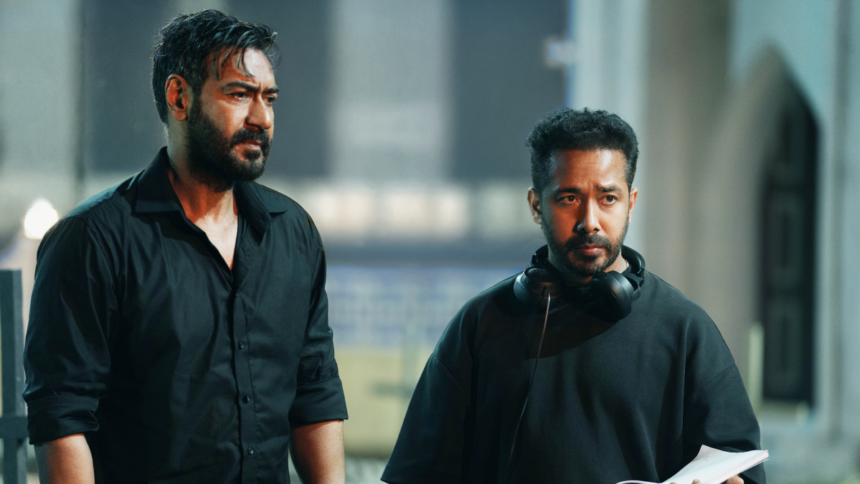
Mumbai, India – Drishyam The Conclusion maintains its deceptive streak. The flimsy mind games of Ajay Devgn’s Vijay Salgaonkar turn into a fulfilling spectacle in the final part of the famed franchise. As the film continues to rake in numbers at the box office, director Abhishek Pathak is pleased with the outcome. “Finally, I have got a chance to take a break,” he says. “It has been overwhelming to see the reactions of people who are liking the film.”
Family is what drives Vijay to single-handedly outwit an entire system, whether it is tackling the wrath of the chain-smoking top cop, SP Rajveer Singh Tomar (Jaideep Ahlawat), or challenging the logical arguments of the hot-shot lawyer, Indrajith Shetty (Prakash Raj). That’s what separates Vijay from Mohanlal’s Georgekutty, as the Hindi third part takes a markedly different approach from Jeetu Joseph’s Malayalam version. Abhishek reveals that the idea to make an original third part came after the release of Drishyam 2. “While many loved the film, there was still a section of audiences who were still talking about the Malayalam version. Seeing that, I just felt that I had to make my own film next time,” says Abhishek, who has co-written the film with Aamil Keeyan Khan and Parveez Shaikh.
Drishyam: The Conclusion is being considered better than Malayalam’s Drishyam 3, which received mixed reviews. “We knew that we had to write well for people to like our film. There would be comparisons, and we wanted to set the benchmark with our writing and craft,” Abhishek says. The writer-director reached out to Jeetu Joseph when the film’s screenplay was ready and offered the Malayalam filmmaker to read the Hindi original. “I told them that I can make them read our script. But they were sure not to do that. I am glad that ultimately they made their version and we made ours,” he says.
The difference in Abhishek’s approach is apparent in how he shapes the film as an entertainer, full of pulpy twists and dialoguebaazi. “I want general theatre-going audiences to have fun. We are making films for crores of people globally, who should be able to connect to it and enjoy,” he opines. Perhaps that’s why the franchise has witnessed growing popularity on social media in the form of memes ever since the first part came out in 2015.
The most viral among them is about October 2, the day when Vijay’s family supposedly went to an ashram. The third part releasing on the same date is a nod from the makers to the franchise’s vibrant afterlife. “There were few elements in the third part too that we knew would become memes,” Abhishek says. However, some surprised him, like the scene involving actor Ajit Singh Palawat, where he rehearses the dialogue, “Sab madeera peeke sogaye,” which has become a sensation on Instagram reels. “I never thought that it would go viral like this,” says Abhishek.
Another talking point has been Gaitonde (Kamlesh Sawant), the arch-rival of Vijay. While the character had a serious tone in Drishyam, he shifts into comical touches this time. “We realised along the way that even though Gaitonde is not cracking any jokes, the way he talks as an actor is quite funny. So, we wrote some punches for him intentionally,” says the writer-director. Beneath the comedic cover and thrilling beats, Drishyam: The Conclusion makes a point about truth and manipulation as Vijay masterfully deceives everyone around him, becoming an allegory for the post-truth world. “Everyone knows how it is so easy to send information that you want to go all around. If you use it wisely, it can help you, or it can damage you as well. All of that was in our head, and we wanted to use it in the story,” Abhishek says.
Must Read: Kazi Nazrul Islam: The Forgotten Voice of Durga Puja and Bengal’s Pluralism
For Abhishek, the key to building suspense is spending time with the screenplay without rushing for the shoot. “A screenplay needs time to live and breathe. A film can become messy otherwise,” he says. That’s what helped strengthen the beats in Drishyam The Conclusion, which were put to test in several narrations. “I remember narrating the screenplay to so many people and then waiting for their reactions on some pivotal moments to see if they could figure out the twist. No one could really decipher.
That’s how we realised that the suspense was working out,” he says. Even after all this, conversations about the film are filled with remarks about logical inaccuracies. Abhishek reacts to this, saying, “We have thought about all of this. Maybe people need to watch the film again to clear their doubts. They are not looking closely enough. I enjoy the chatter around it, whether it is negative or positive.”