In 2026, genuine fashion critique can’t be heard over the claps and front-row selfies. Can the real critics please stand up?
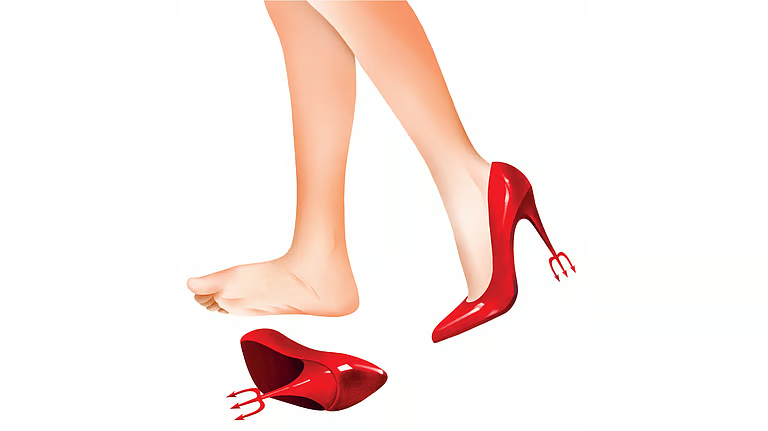
Twenty years ago, Miranda Priestly (Meryl Streep) made it clear that a blue—sorry, cerulean—sweater is never just a sweater. The Devil Wears Prada caught the butterfly effect in action: runway to rack, designer to discount bin. Worth trillions and powering entire economies, fashion has never been just about the clothes.
Priestly was a critic, and criticism once mattered. Two years after the film released, Cathy Horyn was famously banned from an Armani show after writing a scathing review for The New York Times.
But today, the system has changed and criticism is dead. Unfortunately so, in Bandana Tewari’s view, because fashion remains an incisive lens through which to read sociological change. The former Vogue India editor-at-large echoes Priestly: “We have reduced fashion critique to clothes; defiled it into a bouquet with no thorns.”
Too Close for Comfort
Fashion coverage in India has long been relegated to supplements and tabloids, while fashion magazines have a completely different prism as they are dependent on access and advertisements; reducing the journalist to what Shefalee Vasudev deems “the easiest to influence.” The editor-in-chief of The Voice of Fashion says, “Look at how spoiled fashion journalists are. Tickets, hotel rooms, gifts all laid out. Editors wearing clothes of the designers at shows they are [meant to be critiquing].”
According to Vasudev, this incestuousness cannot nurture criticism. Tewari agrees—one can’t be a brand ally and still expect to have free will. “To be a critic, you have to occupy a difficult position,” Vasudev says. “You have to give yourself permission—out of respect for both your work and theirs—to say what needs to be said.”
The Education Gap
Nonita Kalra, launch editor of Elle India and now editor-in-chief at Tata CliQ Luxury, traces the problem to a lack of education and understanding of fashion history. Behind the fantasy lies business, and journalism should treat it that way.
“When fashion week first began in India, there was no ecosystem of trained critics,” she explains. “What emerged instead was straightforward trend-reporting in place of evaluation. Any form of critique was often received as a personal attack.”
The Global Standard
Globally, this is not the case. She points to The New York Times chief fashion critic Vanessa Friedman, who openly expressed dissatisfaction with designer Maria Grazia Chiuri’s work at Dior, then celebrated her return to Fendi with equal conviction. The critique was frank, not cruel.
Friedman herself has noted that today’s fashion show audiences are mostly friends of the house, buyers, magazine editors turned cheerleaders, and influencers—some paid by the brand, others hoping to be. Her biggest concern: the steadily shrinking number of true critics in the room.
Clicks Over Context
Social media platforms have become the primary space for fashion criticism. What does that say about traditional critique?
“That they need money more than they need critics,” Tewari says. “I can’t blame them—the business is hardly thriving. But to say fashion critics don’t exist without understanding why they cannot exist…we’re stifled.”
The economics of publishing mean that critique is often sacrificed for commerce. Legacy brands dictate the narrative, shaping how magazines cover fashion, and sponsorships create a dependency that limits what writers can say.
PR culture has only amplified this. Brands act as strict custodians of their image. “The only time we hear anything contrary that goes viral would be from an independent voice sitting in an obscure place,” says Tewari—a nod to the popular Instagram critic Diet Sabya.
The Influencer Era
Kalra appreciates that social media has created an army of foot soldiers for fashion. Influencers take the conversation around fashion to a larger audience and make it more democratic. But while larger numbers mean greater volume, they do not always mean greater sense. At times, the criticism is personal, superficial, or worse, paid for.
“I don’t think of myself as a fashion critic,” says content creator Sufi Motiwala. “I think of myself as a fashion commentator. What felt missing was people talking about how clothes made them feel, how wearable or bearable they were.”
What’s Left to Say
Vasudev argues that beyond the medium, India needs its own lens for criticism. “Criticism will differ because of our cultural tenets. The Indian model must keep economic realities, production systems, traditional hierarchies, and class and caste very much in mind.”
In the absence of a new generation willing to take the baton, one can call the time of death for fashion criticism—and perhaps for the industry itself. Fashion has never been a democratic act, yet the urban-rural divide has only widened in an era of craft-washing and hollow applause. It is critics who must call these out: those with context, knowledge, a framework that supports them and above all, a spine.