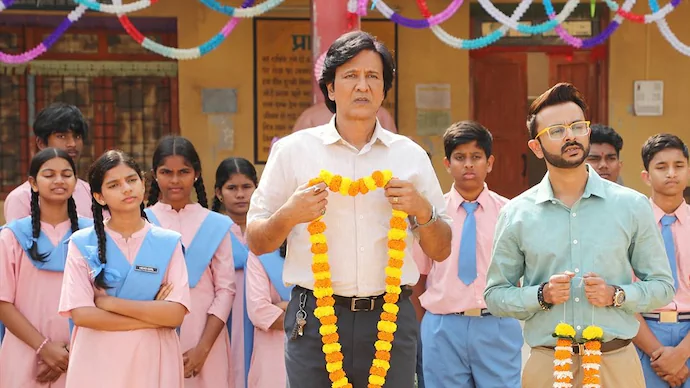
Mumbai, India – If you’ve enjoyed Panchayat, Kota Factory, or Aspirants, the new Prime Video series Adarsh Baal Vidyalaya will instantly feel like home. Created by former TVF creatives Biswapati Sarkar and Sameer Saxena under their banner Posham Pa, the show swaps panchayat offices and coaching institutes for a crumbling government school. It uses its signature blend of slice-of-life storytelling, gentle humor, and small heartbreaks to offer a warm and timely commentary on an education system that often fails the very children it’s meant to nurture.
Set in the fictional town of Tinki Toli on the outskirts of Delhi, Adarsh Baal Vidyalaya is a government school that is ‘adarsh’ (ideal) only in name. Classrooms are falling apart, neighbors use the campus to dry clothes, and the local MLA has converted part of the premises into guest accommodation. The show centers on principal Gyaneshwar Tripathi (a terrific Kay Kay Menon), who is motivated to improve the school after learning that principals of top-performing government schools will be sent to Cambridge with their spouses. More than the foreign trip, he wants to give his wife, Sushma (Prachi Shah), a long-overdue reward for her quiet support.
The principal is surrounded by a wonderfully eccentric staff room. Newly appointed maths teacher Kanchan (Prasanna Bisht) is immediately asked to teach physics due to a teacher shortage. School counselor Mukul (Naveen Kasturia) struggles to connect with his own teenage daughter while trying to help his students. Hindi teacher Hansraj (Abhimanyu Singh), who named his daughters Sangya and Kriya out of his love for grammar, secretly runs a side hustle to survive. Every character feels lived-in, and the humor—from children believing “mass” refers to Allu Arjun to a student saying “children are here to spread happiness”—emerges organically from their world.
The series shines brightest when it quietly opens up important conversations. One strong chapter follows a biology teacher’s awkward attempt to discuss menstruation and sex education, turning the lesson into a song and highlighting how uncomfortable classrooms remain with basic biology. Elsewhere, the show touches upon child marriage, dowry, internet fame, and the growing acceptance that success isn’t just about becoming a doctor or engineer. A particularly effective episode sees topper Purva lose recognition because a clerical error awards her prize to a boy named Purav, exposing how casually institutions dismiss young girls’ achievements. Like Kota Factory, the show reminds us that sometimes all it takes is one teacher believing in a child for them to start believing in themselves.
The performances are uniformly strong. Kay Kay Menon brings warmth and sincerity to Tripathi, with an emotional payoff involving an ex-student standing out as one of the show’s finest moments. Prasanna Bisht impresses as a teacher wanting to become a mentor, while Naveen Kasturia balances humor and vulnerability. Abhimanyu Singh gets some of the funniest lines, Archana Puran Singh is a pleasant surprise in a restrained role, and Deven Bhojani is entertaining as the meddling MLA.
While the writing remains consistently thoughtful, the screenplay isn’t always as engaging. At seven episodes, the series often feels longer than necessary. The creators deliberately avoid dramatic highs, staying rooted in everyday life, which causes the narrative to lose momentum at times. Despite caring for these characters, you wish the story would move faster. However, Adarsh Baal Vidyalaya feels incredibly timely, arriving amid national debates on competitive exams like NEET and the state of government schools. It doesn’t romanticize its setting or pretend to have all the answers. Instead, it reminds us that classrooms are shaped less by buildings and more by the people standing at the blackboard—a message that stays with you long after the credits roll.