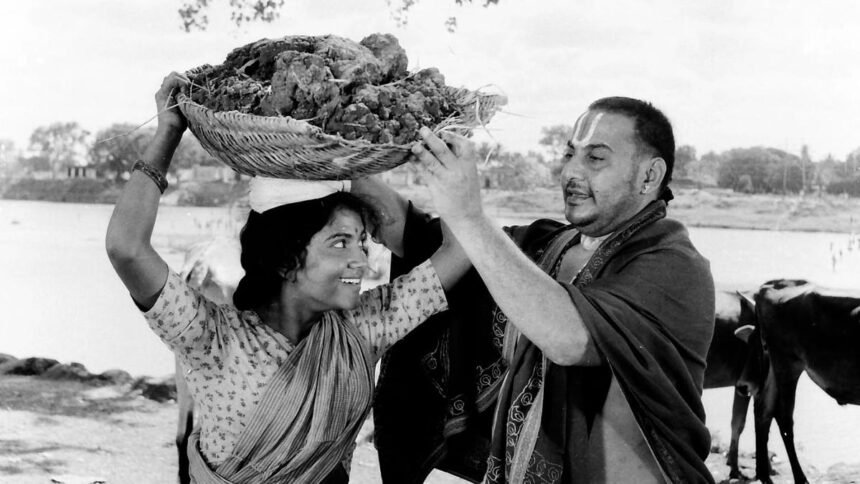
At a time when the Kannada film industry is witnessing debates around social issues, a 1977 film by director Siddalingaiah—Hemavathi—remains a powerful testament to caste pride, social hypocrisy, and rigid social norms. Nearly five decades later, its themes continue to resonate, even as the film itself was largely overlooked in the history of Kannada cinema.
The 17th edition of the Bengaluru International Film Festival (BIFFes) held earlier this year featured a segment titled ’50 Years of Cinematic Journey,’ which included Hemavathi among the films highlighting contributions of commercial and art filmmakers.
A Film Ahead of Its Time
When Hemavathi was released in 1977, it went largely unnoticed. Yet, actor Udayakumar won the Best Supporting Actor award at the Karnataka State Film Awards that year—a recognition that underscored the film’s contribution to regional storytelling, even as it received no other accolades.
| Aspect | Details |
|---|---|
| Director | S Siddalingaiah |
| Release Year | 1977 |
| Source | Novel by Gorur Ramaswamy Iyengar (published 1934) |
| Lead | GV Iyer |
| Supporting Cast | Udayakumar, CH Lokanath, Yoganarasimha |
| Music | L Vaidyanathan |
| Lyrics | Chi Udayashankar |
| Award | Best Supporting Actor (Udayakumar) – Karnataka State Film Awards |
The Story: Caste and Its Consequences
Set in a Brahmin household, Hemavathi explores how rigid social norms and caste-based expectations affect the life of the protagonist, revealing the emotional and social consequences of such systems.
The story centres on the daughter of a priest who is married to an unemployed man in the city. When he abandons her, she is compelled to return to the village, where she encounters deep-seated, caste-based struggles.
A subplot follows a Dalit girl who, under the guidance of a compassionate Brahmin teacher, discovers her musical talents and rises above social defamation and barriers. Through these narratives, Siddalingaiah visually highlights struggles within familial structures and broader societal constraints imposed by orthodoxy.
Enduring Relevance
Speaking at a session at BIFFes titled ‘Rhythmical Strength of Existence,’ writer Sandhya Rani observed that social prejudices portrayed in Hemavathi remain prevalent, even if discrimination against women and lower castes exists in different formats today.
Writer and film critic Raghunatha Ch Ha added a stark observation: “If a film like Hemavathi were to be made today, it would have faced hurdles and remained unreleased.”
Siddalingaiah: A Socially Conscious Filmmaker
Siddalingaiah directed over 20 landmark films in a career spanning 30 years and was known for his socially conscious filmmaking. Aswathanarayana, the still photographer for Hemavathi, recalls the director’s discipline:
“He was an economic filmmaker, and did not waste raw stock of negatives. He would complete all his preparations before calling ‘Action’ or ‘Cut’. His focus was always on the story and script, regardless of the lead actors and actresses.”
He adds, “Siddalingaiah carved a niche for himself in the nine-decade old history of Kannada cinema through his landmark films, bringing a rural texture through his works. Besides offering entertainment, he succeeded in creating societal awareness among the audience, addressing contemporary social issues without glorifying or politicising them.”
Musical Legacy
NS Sreedharamurthy, film writer and music expert, notes the film’s musical value. “This 140-minute film is still known for its musical values. Songs by S Janaki, PB Srinivas, and Yesudas contributed to its cultural resonance in Kannada film history.”
PB Srinivas delivered devotional pieces with a resonant timbre and innovative techniques, structuring songs like traditional kritis, incorporating aalapana for improvisation, and pallavi-anupallavi-charana for lyrical development.
A Lost Era
Had he lived, Siddalingaiah would have been 90 this year. He withdrew from films after the sudden death of his son Murali, a popular actor in Kannada and Tamil films, in September 2010. When Siddalingaiah passed away in 2015, an era of rural Kannada cinema came to an end as well.